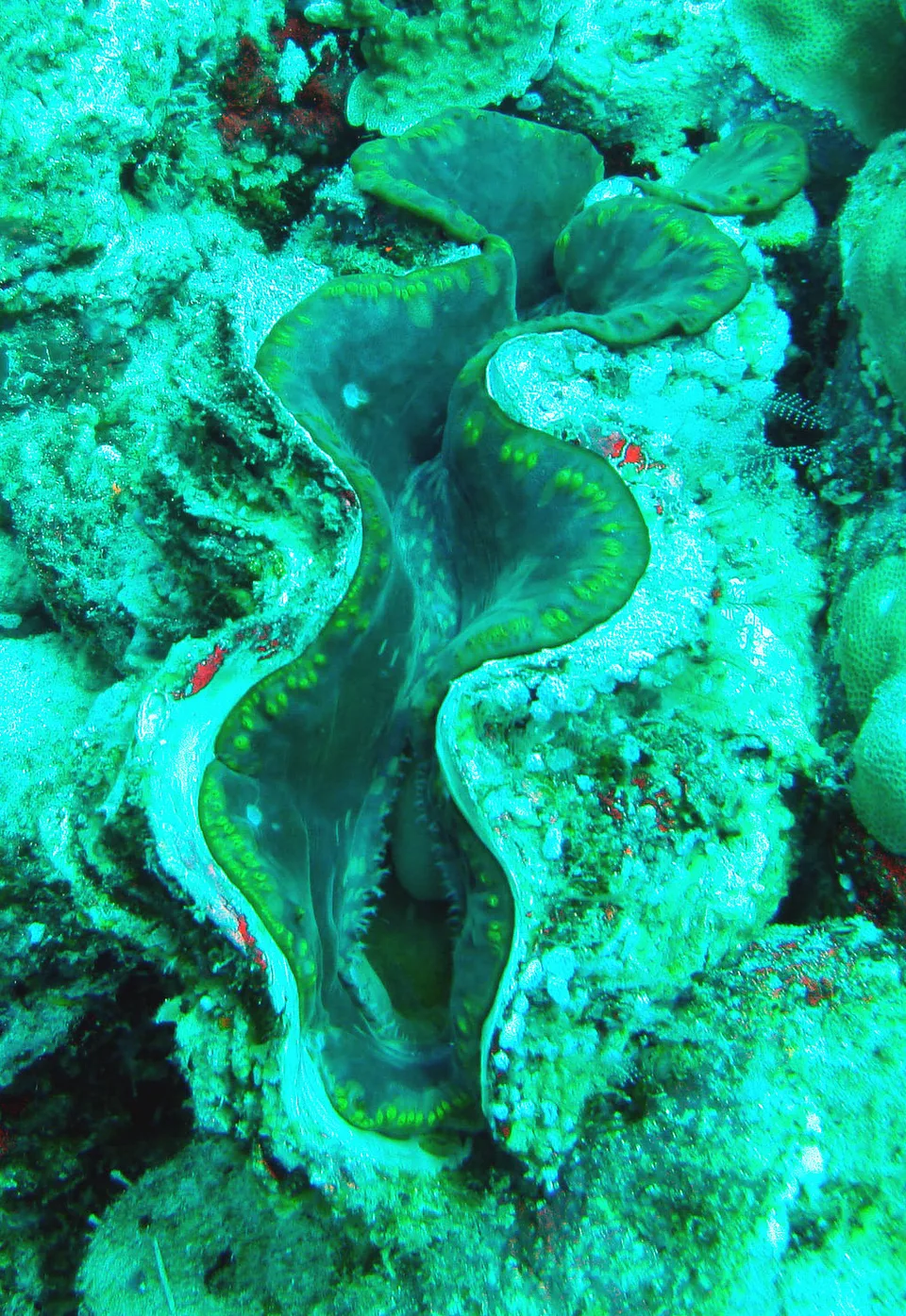
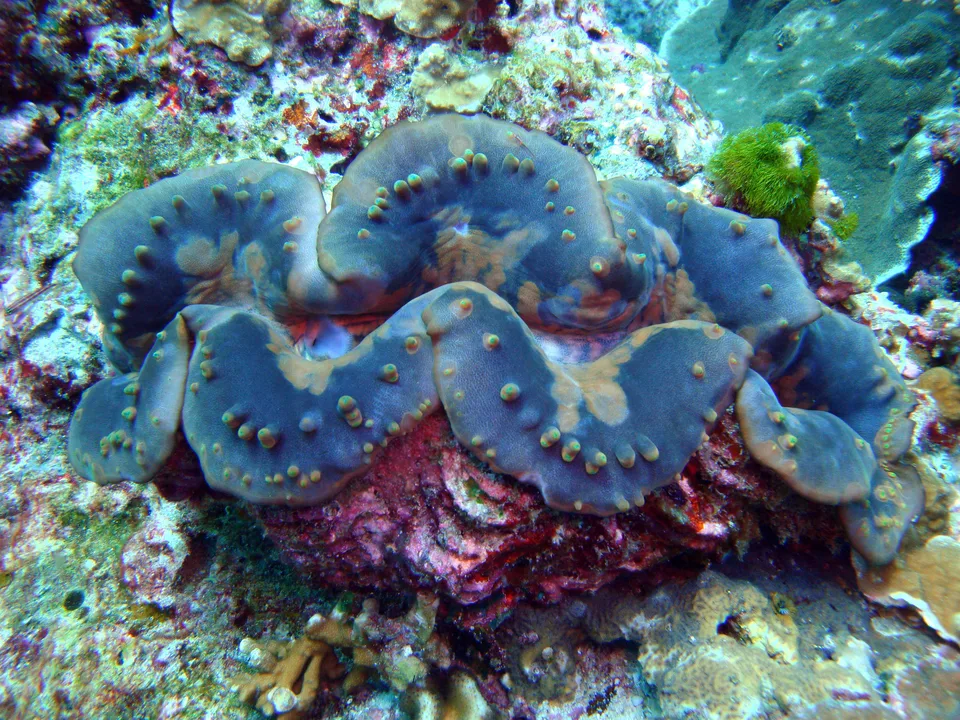
Its meat is edible and historically valued, but this Vulnerable species is threatened by collection and trade. Avoid consuming wild giant clams; use only demonstrably legal, sustainably farmed products where permitted.
Culinary quality / 5
4
Danger level
Harmless
Usual observation depth
1–15 m
Lifespan (years)
100
Behaviour
Sedentary and generally solitary after settling. It lives in symbiosis with photosynthetic algae in its mantle, opens to the light for photosynthesis, and quickly closes its shell when disturbed. Adults are simultaneous hermaphrodites and release their gametes into the water.
Observation zones
Shallow reef flats, reef crests, lagoons and illuminated hard-bottom areas on the outer reef slope.
Diet
Derives much of its nutrition from symbiotic zooxanthellae and also filters plankton and dissolved organic matter.
Reproduction
Oviparous
Identification marks
The world’s largest bivalve: exceptionally large and heavy shell, with 4 to 5 broad, deeply folded ribs. The exposed mantle is brightly colored and often green, brown, blue, or yellow; small iridescent eyes line its margin.
Similar species
May be confused with other Tridacna species, notably T. derasa, T. squamosa and T. maxima. T. gigas is much larger than T. maxima and generally has broad, strongly folded shell ribs; T. squamosa bears more conspicuous foliose scales, while the folds of T. derasa are smoother.
Approach rules
Observe the animal without touching it, standing on it, or placing equipment nearby. Keep a respectful distance of at least 1 m, avoid shading it for long periods, and do not feed it or attempt to open its shell. Avoid using flash if it causes repeated closures.
Protection
Classified as Vulnerable on the IUCN Red List. International trade in Tridacna gigas is regulated by CITES Appendix II; specimens and shell products require the appropriate documents for international trade.