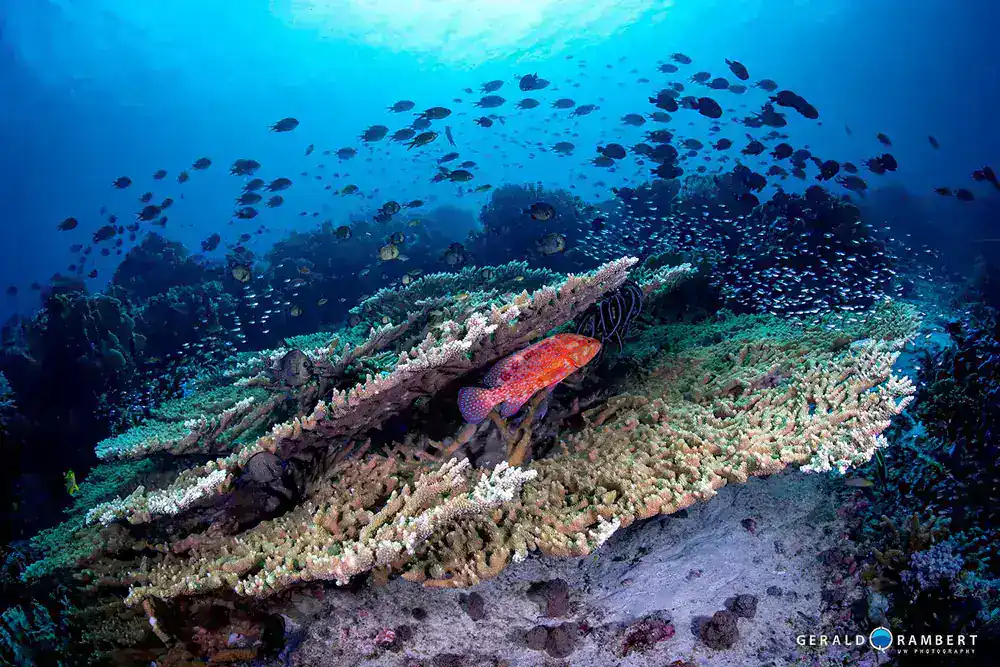
Reef environments, particularly around coral reefs.
Distribution
Found in the Indo-Pacific region.
Conservation status
Least Concern
Edibility
Edible and regarded as a good food fish, but large reef predators can carry ciguatera toxins. Consume only fish from reliable, monitored sources; cooking does not destroy ciguatera toxins.
Culinary quality / 5
4
Danger level
Harmless
Usual observation depth
5–60 m
Behaviour
Generally solitary and strongly associated with a home range on the reef. A territorial ambush predator, it rests near shelters and is most active at dawn, dusk, and at night. Adults may gather to spawn.
Observation zones
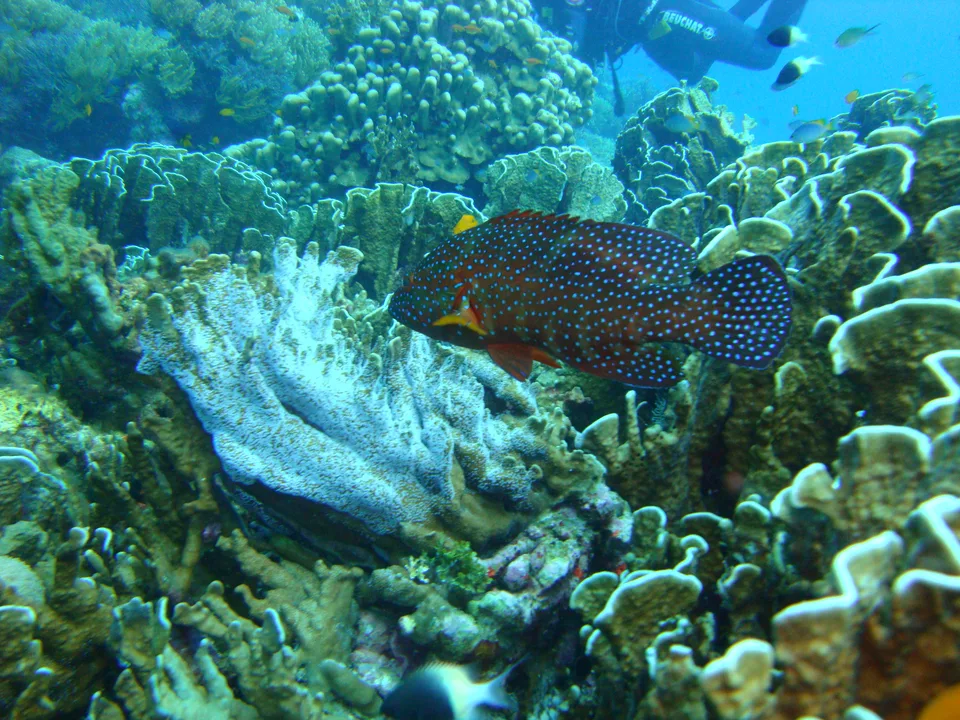
Reef slopes, coral gardens, channels, lagoons, rocky reefs, ledges, crevices and overhangs; occasionally on deeper reefs.
Diet
Carnivore. It feeds mainly on fish, especially small reef fish, and also consumes crustaceans such as crabs and shrimp.
Reproduction
Oviparous
Identification marks
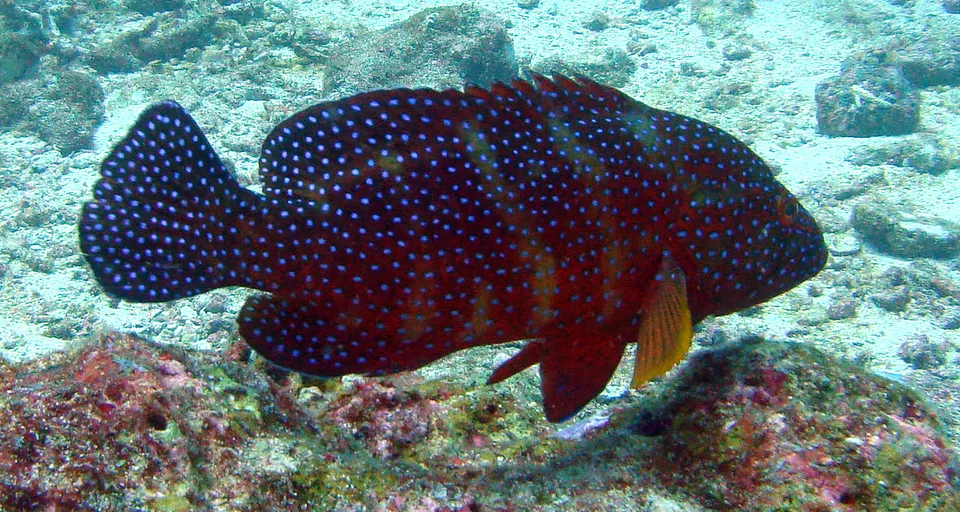
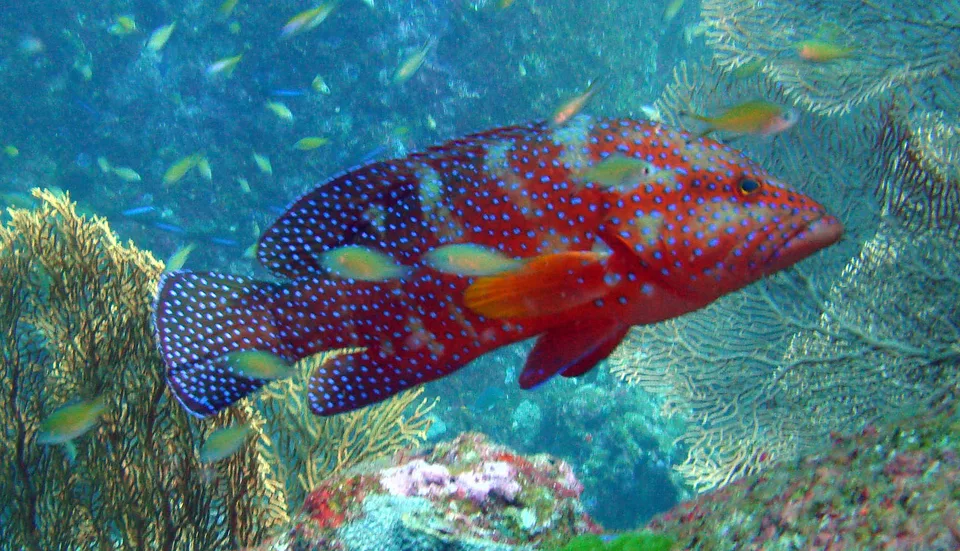
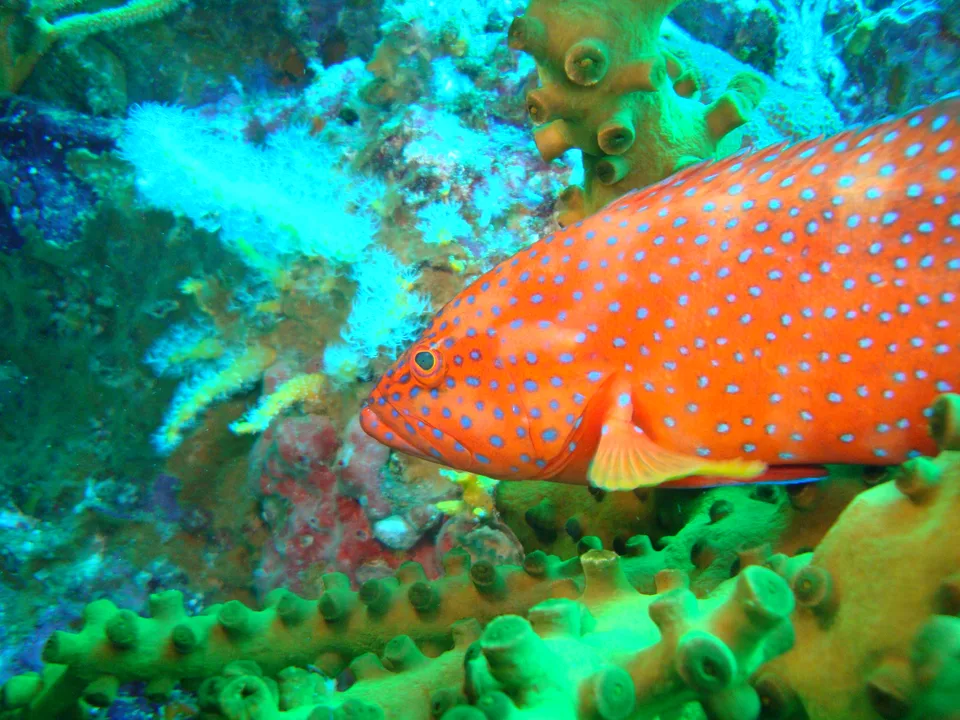
Robust grouper with a rounded tail, body red to orange-red and densely covered with small bright blue spots. Blue markings are also present on the head and fins; the body is generally more uniformly red than in many similar groupers.
Similar species
It can be confused with other spotted groupers from the Indo-Pacific, notably Cephalopholis cyanostigma and Plectropomus leopardus. C. miniata is typically robust and broadly orange-red with numerous small blue spots; P. leopardus is more elongated, while C. cyanostigma often exhibits less uniformly red coloration and more visible blue margins on the fins.
Approach rules
Approach slowly and calmly, without blocking its escape route and without touching the reef. Keep a respectful distance of approximately 2 to 3 m, do not corner it or touch it, avoid repeated flashes at close range, and never feed it.
Protection
Globally assessed as “Least Concern” on the IUCN Red List. Nevertheless, it remains vulnerable to local depletion due to reef fishing and catches; respect marine protected area regulations and favor responsible sourcing.