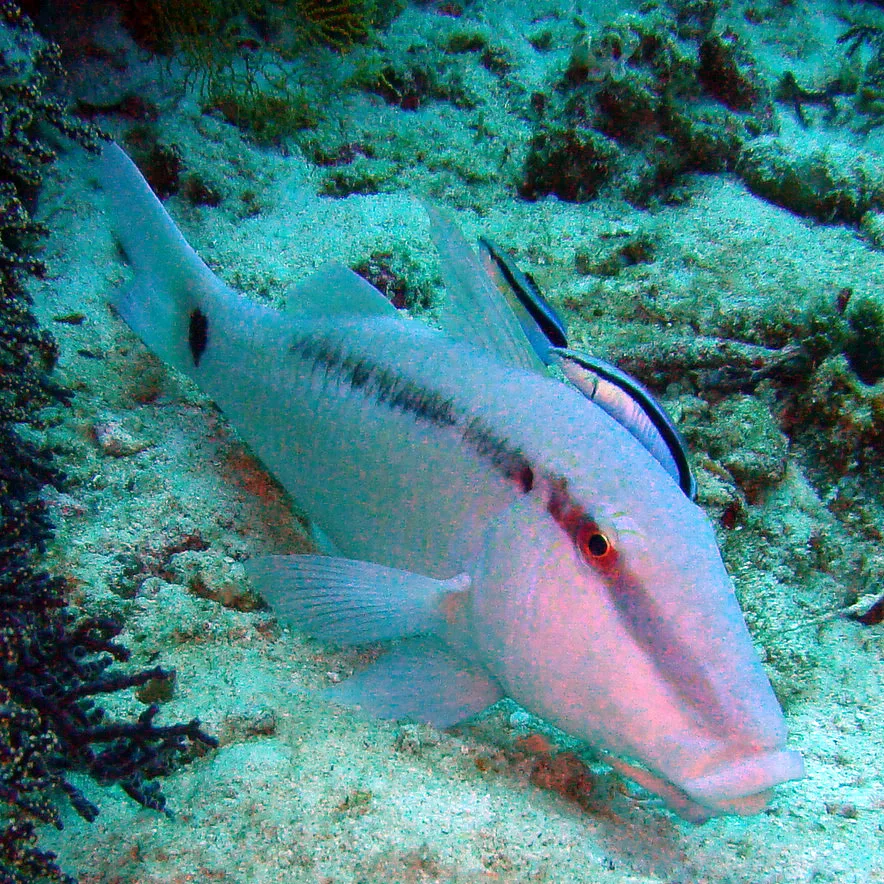
Edible and harvested in parts of its range. Flesh is generally considered good, but consumption advice should follow local seafood-safety guidance, especially regarding ciguatera risk in tropical reef fishes.
Culinary quality / 5
3
Danger level
Harmless
Usual observation depth
3–30 m
Behaviour
Observed alone, in pairs or in small loose groups. It actively searches the substrate with its sensory barbels, especially during the day, and can rapidly change its coloration.
Observation zones
Reef, reef flat, lagoon, rubble zones, sand and seagrass bed margins.
Diet
Benthic invertebrates, notably crustaceans, worms, mollusks, echinoderms and other small animals unearthed in sand or debris.
Reproduction
Oviparous
Identification marks
Large goatfish with two separate dorsal fins and a pair of long white barbels beneath the chin. Coloration is variable, but the characteristic pattern often includes a dark dash on the flank and a distinct dark spot near the caudal peduncle.
Similar species
It can be confused with other goatfish of the genus Parupeneus, notably the yellow-saddled goatfish (Parupeneus cyclostomus) and the manybar goatfish (Parupeneus multifasciatus). The combination of a lateral stripe and a dark spot on the caudal peduncle, together with its variable coloration, helps identify P. barberinus.
Approach rules
Approach slowly and stay at least 2 to 3 m away. Avoid blocking its foraging path or disturbing the sediment. Do not touch, chase, feed, or handle it; use flash sparingly and never repeatedly at close range.
Protection
Classified as Least Concern on the IUCN Red List. It is not listed in the CITES Appendices. General protection relies on maintaining reefs and lagoons in good condition and on sustainable fishing practices where it is caught.