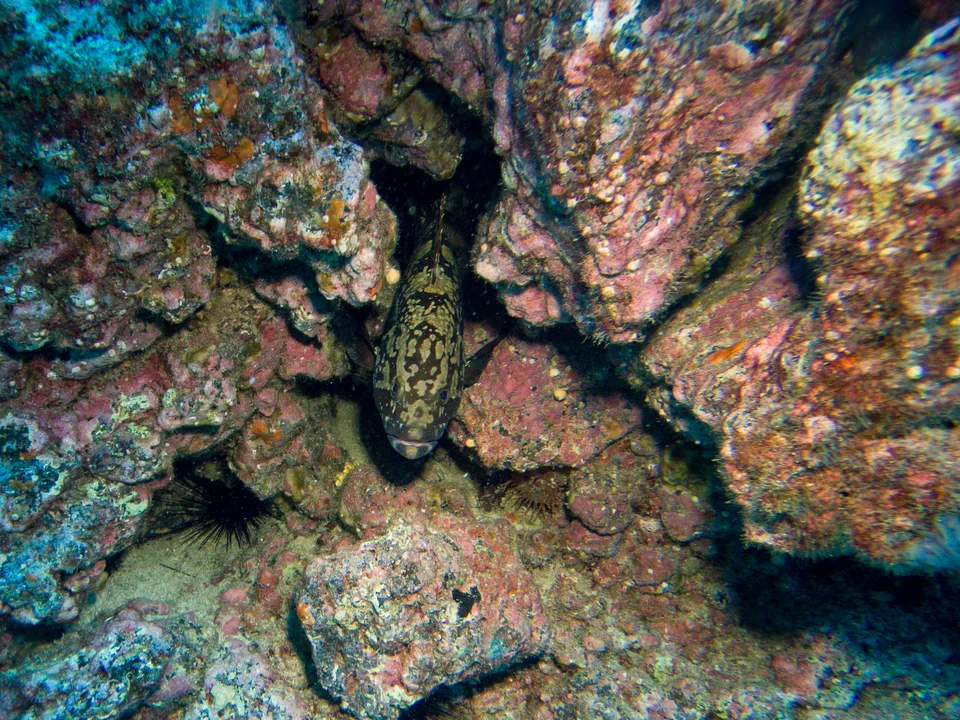
Typically found in rocky reefs and caves at depths of 10 to 100 meters.
Distribution
Found in the eastern Atlantic, particularly around the Canary Islands and Madeira.
Conservation status
Least Concern
Edibility
Edible and highly regarded as food, but larger predatory fish may accumulate ciguatera toxins in some regions. Consume only from safe, traceable sources and follow applicable health and fisheries guidance.
Culinary quality / 5
4
Danger level
Harmless
Usual observation depth
30–150 m
Lifespan (years)
41
Behaviour
Generally solitary and territorial, it stays near reef structures during the day. An ambush predator, it may be more active at dawn, dusk, and at night. Adults may gather seasonally to spawn.
Observation zones
Rocky reefs, reef slopes, overhangs, caves, drop-offs and deep areas with hard bottoms; occasionally near wrecks offering significant shelter.
Diet
Carnivore: primarily fish, crustaceans, and cephalopods.
Reproduction
Oviparous
Identification marks
Large grouper with an elongated, robust body and a wide mouth. Adults are generally grey-brown to dark brown, with irregular pale spots or mottling and darker markings; the fins are mottled. It has the stocky body and long continuous dorsal fin characteristic of groupers.
Similar species
May be confused with the royal grouper (Mycteroperca rubra), generally smaller and more reddish, often covered with clearly visible pale or bluish spots. It may also resemble the dusky grouper (Epinephelus marginatus), which usually has a more rounded caudal fin and a different pattern of yellowish marbling.
Approach rules
Approach slowly and calmly from the side, remain at least 2 to 3 m away, and do not block its path to shelter. Do not touch, pursue, disturb, or feed the animal. Avoid repeated flashes at close range, particularly when it is resting in a cave or crevice.
Protection
Globally assessed as “Least Concern” by the IUCN. The species is not listed under CITES. Fishing pressure and the vulnerability of breeding aggregations warrant monitoring and responsible exploitation.