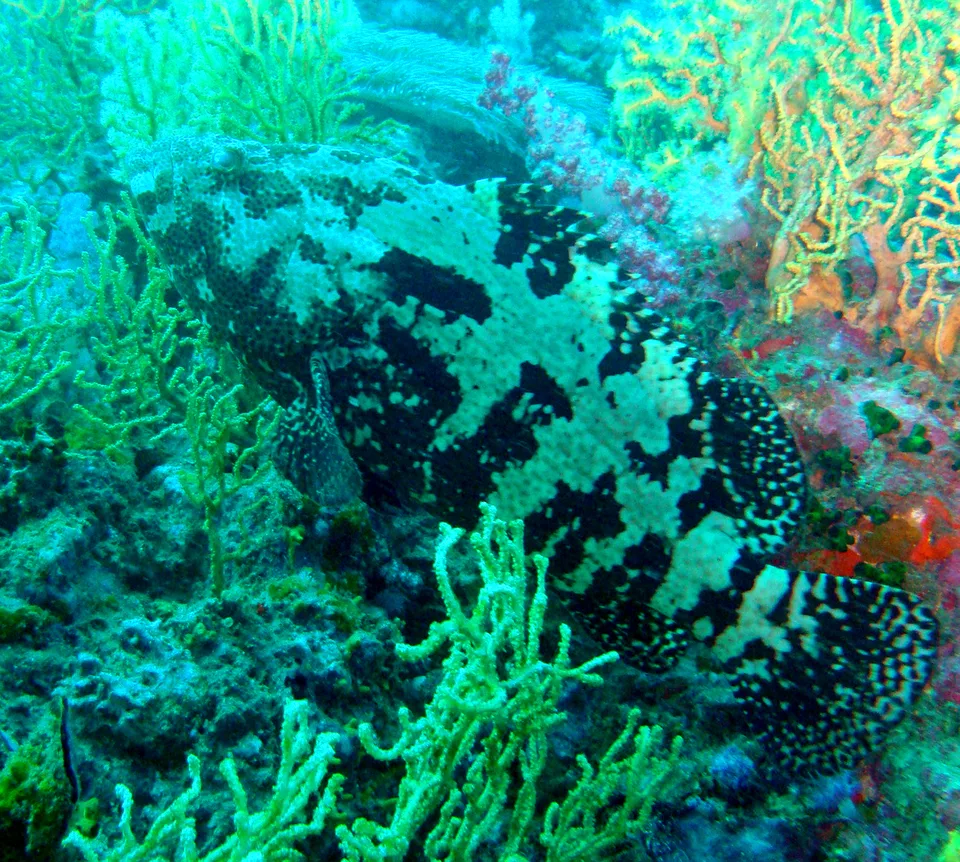
Found in the tropical and subtropical waters of the Atlantic, Indian, and Pacific Oceans.
Conservation status
Least Concern
Edibility
Edible and commercially valued, with firm flesh. Large reef groupers can accumulate ciguatera toxins in some regions; avoid consumption where ciguatera risk is known.
Culinary quality / 5
4
Danger level
Harmless
Usual observation depth
3–40 m
Lifespan (years)
40
Behaviour
Generally solitary and territorial. Sedentary ambush predator, especially active at dawn, dusk and at night; may gather seasonally for breeding.
Mainly fish and crustaceans, supplemented by cephalopods and other benthic invertebrates.
Reproduction
Oviparous
Identification marks
Stocky grouper with a pale grayish-brown body, densely marbled with small dark brown spots and speckles forming a camouflage pattern. Usually has several dark saddle-shaped spots on the back; the fins are also spotted.
Similar species
May be confused with the marbled grouper (Epinephelus fuscoguttatus), generally larger and exhibiting broader, more irregular dark marbling. The camouflage grouper usually has finer, more closely spaced spots, as well as dark dorsal saddle-like markings.
Approach rules
Approach slowly and calmly without blocking its escape route. Maintain a respectful distance, do not pursue it into cracks or caves, avoid repeated flashes at close range, and never feed or touch it.
Protection
Not listed in the CITES Appendices. Breeding aggregations and large adults are particularly vulnerable to fishing pressure; avoid disturbing them and support management measures for reef fisheries.