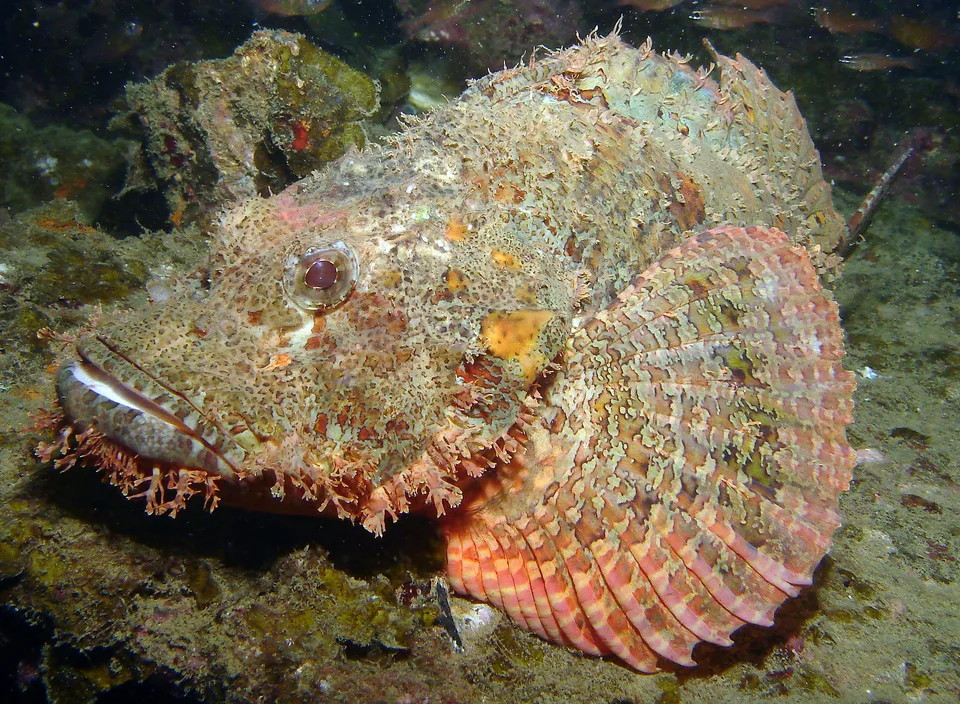
Typically found in shallow waters, often among coral reefs and rocky substrates.
Distribution
Widespread in the Indo-Pacific region.
Conservation status
Least Concern
Edibility
Edible and sometimes eaten, but handle only with great care: the dorsal, anal and pelvic spines are venomous. Reef fish may also carry a location-dependent ciguatera risk.
Culinary quality / 5
3
Danger level
Dangerous
Usual observation depth
3–30 m
Behaviour
Generally solitary, sedentary, and highly cryptic during the day. It waits motionless for its prey and is mainly active at night or in low light.
Observation zones
Reef, reef slope, lagoon, rocky bottom, coral rubble and sand patches near reef structures.
Diet
Ambush predator feeding mainly on small fish and crustaceans, and occasionally on other small benthic invertebrates.
Reproduction
Oviparous
Identification marks
Robust scorpionfish, highly variable and mottled, with a relatively long and pointed snout; numerous cirri and skin flaps on the head; a large mouth; and venomous dorsal spines. Its coloration often mimics algae, sponges or reef debris.
Similar species
Often confused with other Indo-Pacific Scorpaenopsis, notably S. diabolus and S. venosa. Coloration and cutaneous tassels are variable and insufficient; the long pointed snout, as well as the detailed characters of the cephalic spines, cirri and fin rays, are necessary for reliable identification.
Approach rules
Observe without touching or positioning yourself directly above the animal. Keep your hands, knees, and equipment away from the fish and substrate; its venomous spines can cause a painful injury. Keep a respectful distance, avoid repeated flashes, and never feed it or attempt to move it.
Protection
Assessed globally as “Least Concern” on the IUCN Red List. No CITES listing is known. Preserve reef habitat and avoid capturing or disturbing individuals.