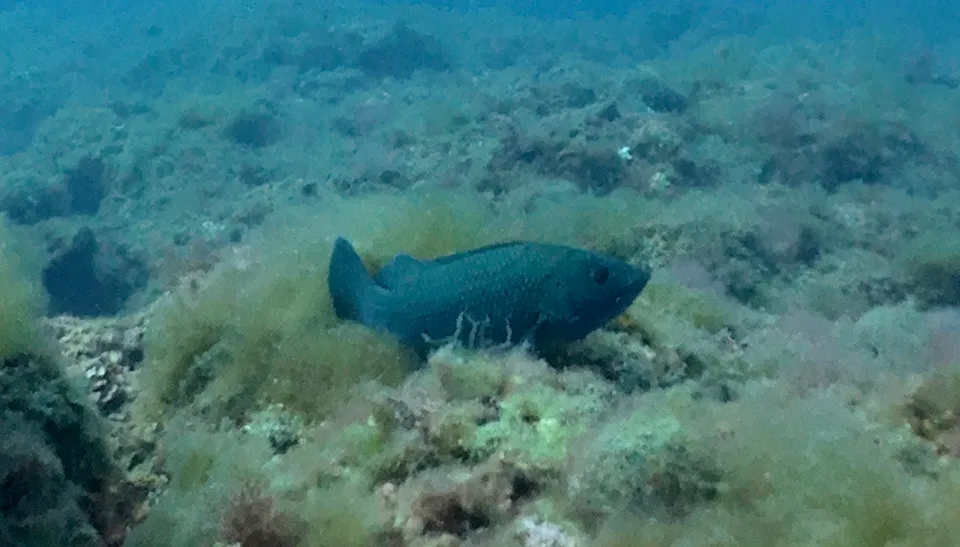
Rocky coastal reefs, boulder fields, rocky ledges, and seagrass beds; often shelters in crevices.
Distribution
Eastern Atlantic from Portugal to Morocco, including nearby Atlantic islands in parts of its range; widespread in the Mediterranean and present in the Black Sea.
Conservation status
Least Concern
Edibility
Edible and regarded as a good-quality food fish. Consume only from clean waters and follow local health and fisheries guidance.
Culinary quality / 5
4
Danger level
Harmless
Usual observation depth
3–30 m
Lifespan (years)
0
Behaviour
Usually solitary or found in small loose groups. A diurnal, bottom-associated wrasse that searches among rocks and vegetation; males may defend breeding territories during the reproductive season.
Observation zones
Rocky reef, boulder slope, seagrass bed, rock wall, crevice and shallow coastal reef.
Diet
Mainly benthic invertebrates, including crustaceans, molluscs, worms and echinoderms; it may also eat small fishes.
Reproduction
Oviparous
Identification marks
A robust, elongated wrasse with thick lips and a long continuous dorsal fin. Adults are generally dark brown to olive-green, often with bluish lines or spots on the head and bluish markings on the scales and fins.
Similar species
Can be confused with the green wrasse (Labrus viridis), which is usually greener and has a different head and body pattern. It may also resemble smaller Symphodus wrasses, but Labrus merula is more robust, larger, and has notably thick lips.
Approach rules
Approach slowly and remain neutral near the bottom; do not corner it at a crevice. Keep a respectful distance, avoid repeated close flash photography, and never feed or handle the fish.
Protection
IUCN Least Concern globally. No CITES listing is known; population and habitat protection measures may apply locally.