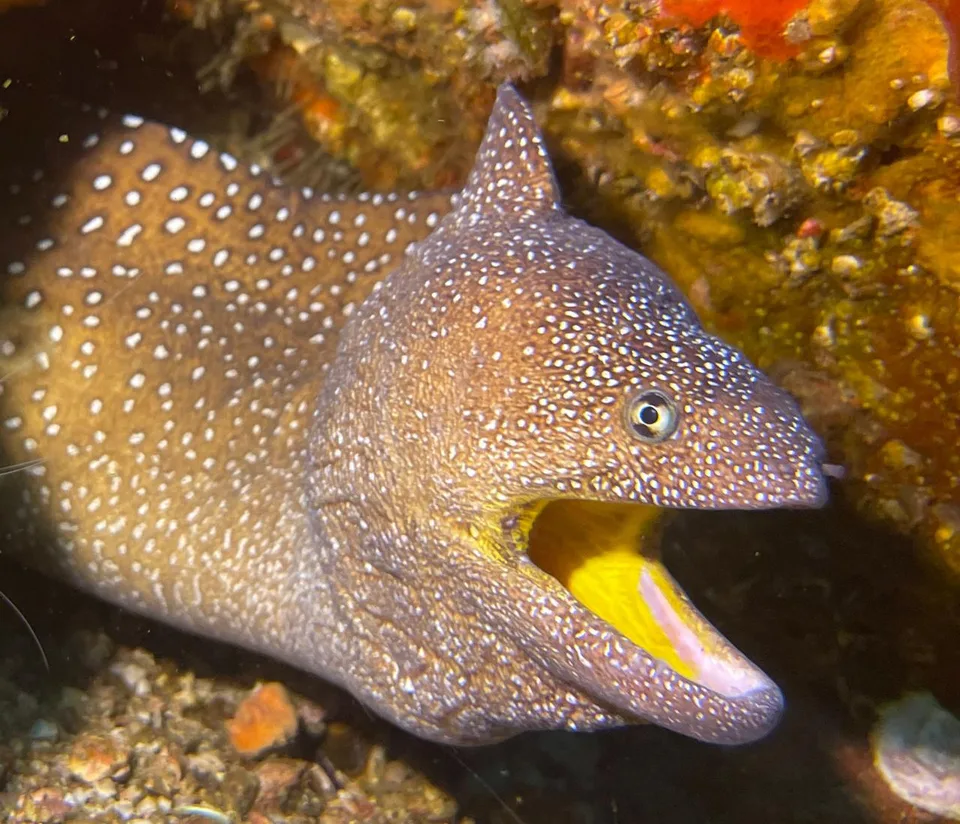
Found in rocky and coral reefs, often hiding in crevices.
Distribution
Indo-Pacific region, including the Red Sea and parts of the Indian and Pacific Oceans.
Conservation status
Least Concern
Edibility
Edible and sold for food in some areas, but large reef morays may carry a significant risk of ciguatera poisoning. Avoid consumption where ciguatera is known or suspected.
Culinary quality / 5
3
Danger level
Caution
Usual observation depth
3–50 m
Behaviour
Generally solitary, discreet and mainly nocturnal. It spends much of the day with its head protruding from its shelter and becomes more active at night to hunt.
Carnivorous predator feeding mainly on fish, crustaceans, and cephalopods.
Reproduction
Oviparous
Identification marks
Very large, robust moray eel, with a dark brown to blackish body covered with large yellow spots or blotches. The dorsal and anal fins have a broad, clearly visible yellow margin.
Similar species
The giant moray (Gymnothorax javanicus) is also large, but generally has a more reticulated, honeycomb-like pattern and lacks the broad yellow fin margins. The undulated moray (Gymnothorax undulatus) bears fine wavy markings rather than large yellow spots.
Approach rules
Observe calmly from outside its shelter and keep hands, cameras and other equipment away from its mouth. Do not touch, corner, feed or provoke it. Avoid flash at very close range; a moray eel can inflict a serious bite if it feels threatened or is conditioned to food.
Protection
Globally assessed as Least Concern on the IUCN Red List. It is not listed under CITES. General recommendations: avoid disturbance, do not feed wildlife and support the conservation of reef habitats.