Edible but small and not generally valued as a food fish. As with other tropical reef fish, ciguatera risk can occur in some areas; avoid consumption where ciguatera advisories apply.
Culinary quality / 5
2
Danger level
Harmless
Usual observation depth
3–30 m
Behaviour
Diurnal, most often observed alone or in pairs, sometimes in small groups. It actively explores reef crevices with its long snout to feed.
Mainly benthic invertebrates collected from crevices, notably small crustaceans, worms, hydroids and other small sessile animals; may also consume coral polyps.
Reproduction
Oviparous
Identification marks
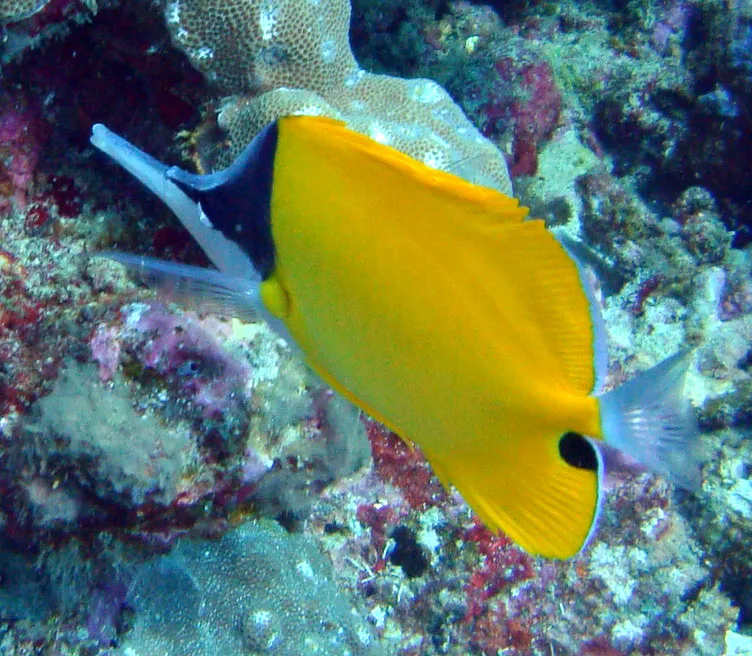
Bright yellow body; black mask crossing the eye; very long, narrow snout ending in a small mouth; rear of body pale and a clearly visible dark eyespot near the rear of the anal fin.
Similar species
Most often confused with the longnose butterflyfish (Forcipiger longirostris). F. longirostris has a distinctly longer and thinner snout and usually possesses 10 dorsal spines, compared with usually 8 to 9 in F. flavissimus.
Approach rules
Approach slowly from the side, avoid blocking its path along the reef, and keep at least 2 m away. Do not touch, chase, or feed it. Avoid flash photography, especially during repeated close-up observations.
Protection
Classified as “Least Concern” globally by the IUCN. It is not listed in the CITES Appendices. Protect reef habitat and comply with site rules and applicable collection restrictions.