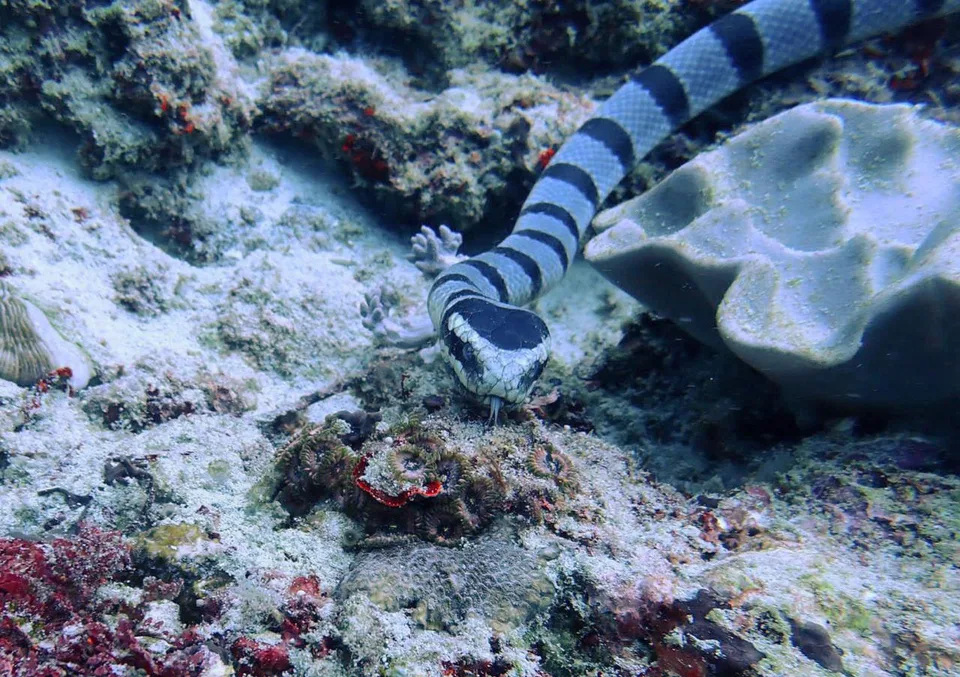
Coastal waters, often found in coral reefs and rocky areas.
Distribution
Found in the tropical and subtropical waters of the Indo-Pacific region.
Conservation status
Least Concern
Edibility
Not suitable for consumption: this is a highly venomous sea snake. Do not catch, handle or eat it.
Danger level
Dangerous
Usual observation depth
?–20 m
Behaviour
Generally solitary. An active visual hunter, it searches mainly during the day for eels in reefs and crevices. It must breathe air and often rests on land; it is usually non-aggressive, but may bite if handled, threatened, or prevented from fleeing.
Observation zones
Coral reefs, reef flats, lagoons, rocky shores, shallow sand near reefs and island beaches.
Diet
Mainly eels, including moray eels and conger eels; occasionally other elongated fish.
Reproduction
Oviparous
Identification marks
Slender sea snake with a strongly flattened tail, with broad black bands alternating with pale bluish-gray bands around the body. The head is dark on top, with a bright yellow snout and upper lip; the tail is paddle-shaped.
Similar species
Often confused with the blue-lipped krait (Laticauda laticaudata). L. colubrina is distinguished by its distinctly yellow upper lip and snout, whereas L. laticaudata has bluish or dark lips and a darker snout.
Approach rules
Observe from several meters away and always leave a clear escape route. Never touch, restrain, pursue, corner, or lift it, including on land. Avoid using flash at very close range and never feed it.
Protection
IUCN: Least Concern (LC). The species is not listed in the CITES appendices. Avoid any disturbance and comply with applicable local wildlife protection regulations.