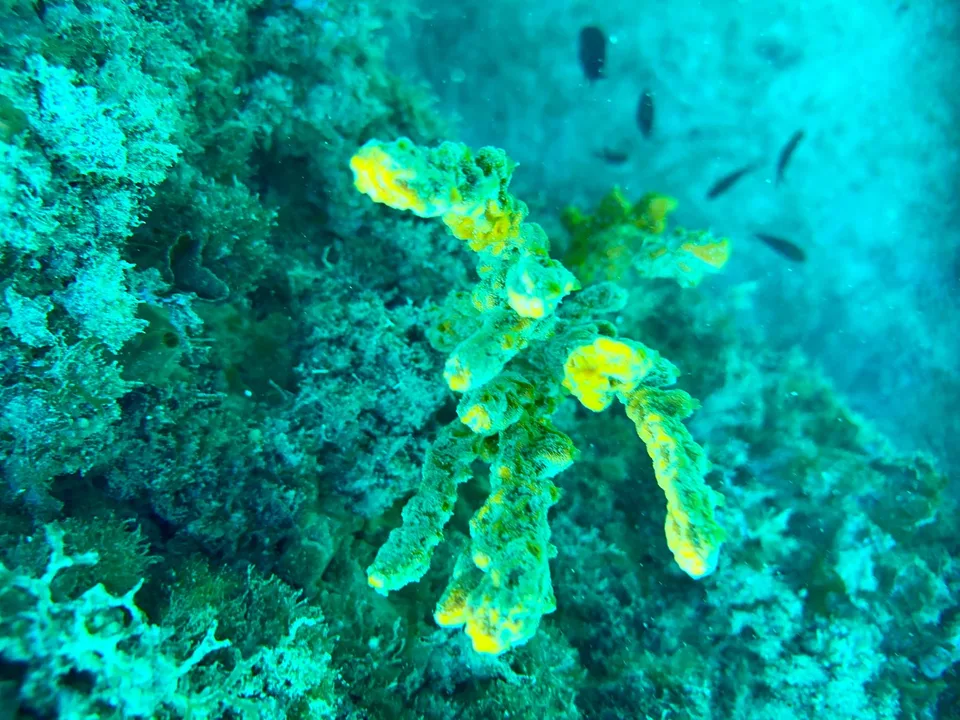
Sessile sponge on hard rocky bottoms, vertical walls, overhangs and coralligenous habitats, often in dimly lit water.
Distribution
Mediterranean Sea and adjacent northeastern Atlantic waters.
Conservation status
Not Evaluated
Edibility
Not edible; this sponge is not a food species and should not be collected for consumption.
Danger level
Harmless
Usual observation depth
15–50 m
Lifespan (years)
0
Behaviour
A sessile, usually solitary sponge that may occur as several individuals on suitable rock. It continuously filters suspended particles from the water.
Observation zones
Rocky reef, wall, overhang, coralligenous reef and shaded hard-bottom habitats.
Diet
Filter feeder, drawing water through pores and retaining bacteria, microscopic plankton and organic particles.
Reproduction
Unknown
Identification marks
Usually a yellow to orange, thickly encrusting or cushion-shaped sponge with a rough surface bearing rounded to conical wart-like projections. Oscules are small and scattered.
Similar species
It can be confused with other Mediterranean Axinella species. The branching Axinella damicornis and Axinella polypoides differ by their distinctly upright branched form; A. verrucosa is mainly massive or cushion-like with blunt warty projections. Sponge identification may require microscopic examination of spicules.
Approach rules
Observe without touching, scraping or collecting. Maintain good buoyancy to avoid contact or sediment disturbance; do not feed it. Use flash only when necessary and avoid prolonged close lighting.
Protection
No specific global protection listing is known. Avoid collection and follow rules applicable to marine protected areas and protected benthic habitats.