Edible and locally taken as a food fish. Flesh is generally considered acceptable, but fish from reef areas may carry ciguatera risk in some regions; follow local health advisories.
Culinary quality / 5
3
Danger level
Harmless
Usual observation depth
3–20 m
Behaviour
Generally active during the day. Adults live alone, in pairs, or in small loose groups, while juveniles may be more gregarious. It forages near the bottom and takes refuge in the reef structure when disturbed.
Feeds mainly on benthic invertebrates, including small crustaceans, worms and mollusks; it may also consume small fish and other small animals living on the bottom.
Reproduction
Oviparous
Identification marks
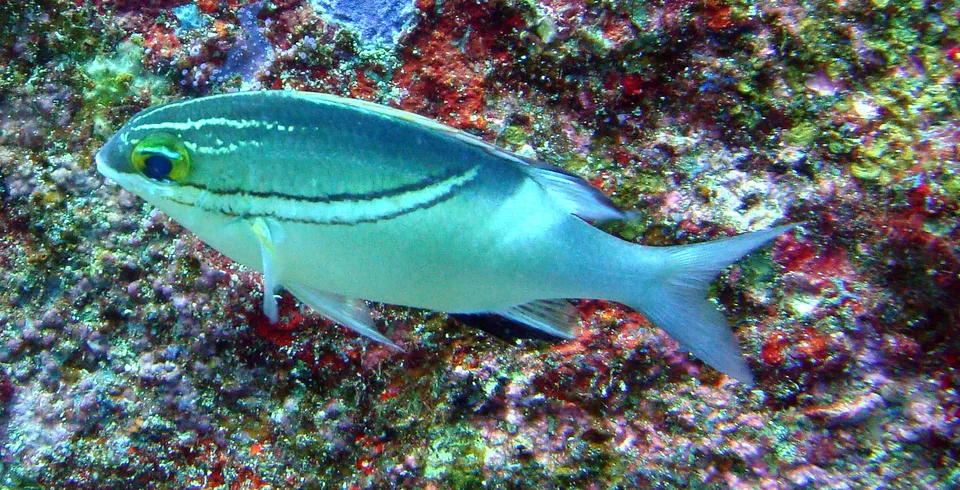
Monocle bream with an oval, laterally compressed body, yellowish on top and paler underneath. Two clearly visible longitudinal blue lines run along the head and body; a dark band crosses the eye. The caudal fin is often yellowish, and its lower lobe may be elongated.
Similar species
It can be confused with other monocle breams of the genus Scolopsis, notably Scolopsis trilineata and Scolopsis monogramma. S. bilineata is distinguished by its two prominent longitudinal blue lines and its characteristic dark band across the eye; closely related species differ in the number, position, or continuity of the body lines.
Approach rules
Approach slowly and calmly without blocking its escape route to shelter. Keep a respectful distance, avoid touching the reef, do not feed it, and avoid close, repeated flashes.
Protection
Classified as “Least Concern” (LC) by the IUCN. It is not listed in the CITES appendices. Adopt responsible diving and fishing practices on reefs and comply with applicable local conservation measures.