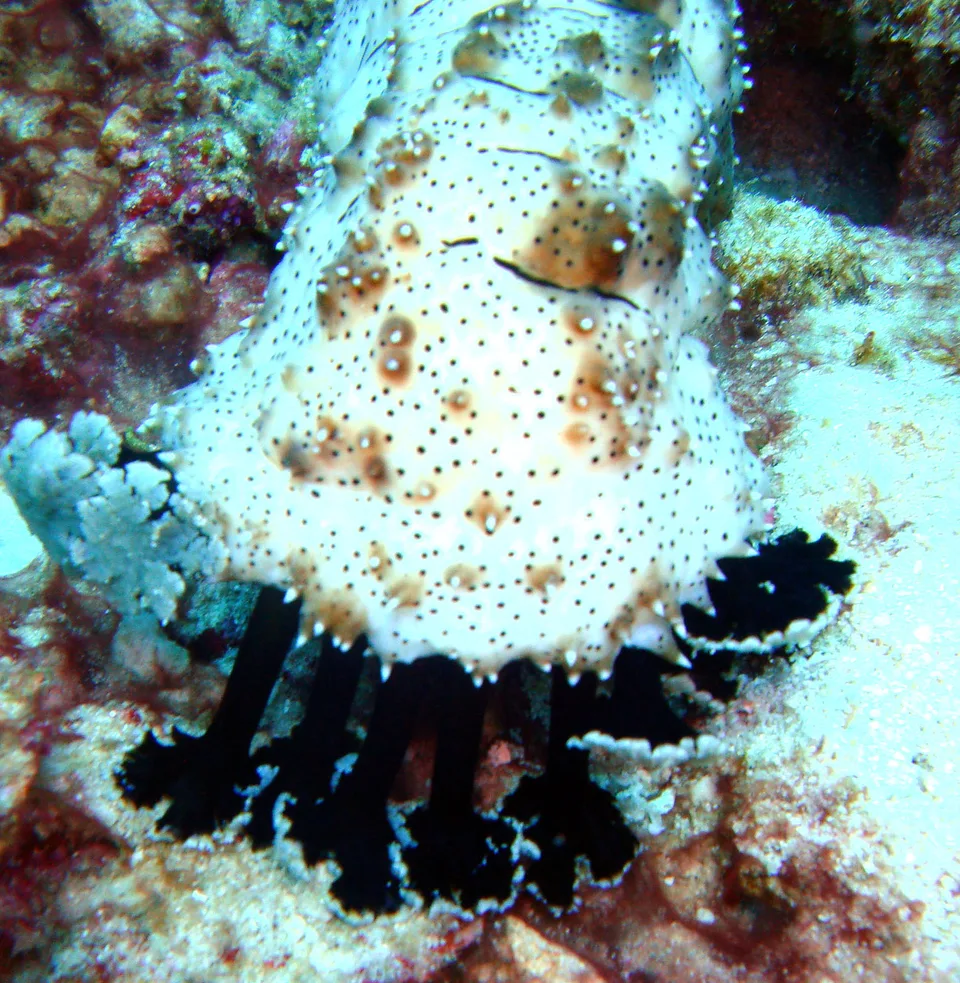
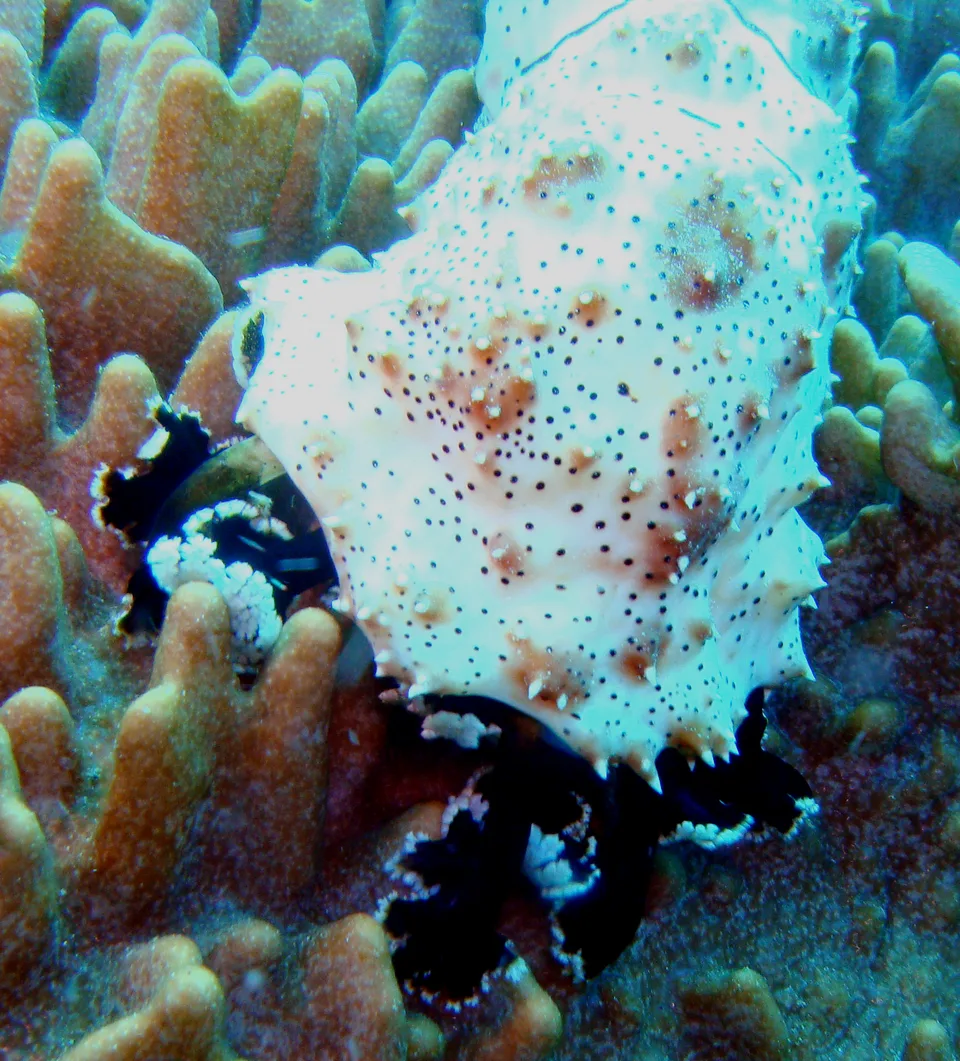
Found on sandy or muddy bottoms in shallow waters.
Distribution
Widespread in tropical and subtropical oceans.
Conservation status
Least Concern
Edibility
Edible and sometimes collected for the sea-cucumber trade, but culinary use is not well documented. Consumption should be avoided where stocks are depleted; check local regulations and health advice.
Culinary quality / 5
2
Danger level
Harmless
Usual observation depth
1–20 m
Behaviour
Generally solitary and moving slowly. It feeds mainly by ingesting surface sediments and may remain partially buried or concealed during the day.
Deposit feeder: ingests sand and sediments, from which it extracts detritus, organic particles, microalgae and microorganisms.
Reproduction
Oviparous
Identification marks
Elongated and cylindrical sea cucumber, with a pale beige to brown body bearing clearly visible dark longitudinal lines or stripes; mouth surrounded by feeding tentacles.
Similar species
May be confused with other Indo-Pacific species of the genus Holothuria. Its persistent dark longitudinal stripes distinguish it from Holothuria atra, which is uniformly black, and Holothuria leucospilota, which is generally dark and faintly marked.
Approach rules
Observe without touching, lifting, or moving the animal. Maintain good buoyancy to avoid resuspending sediments; do not feed it and avoid using the flash at very close range.
Protection
IUCN: Least Concern (LC). The species is not listed in the CITES Appendices. Sea cucumbers may be vulnerable to local overexploitation; comply with site-specific conservation measures.