Its flesh is edible, but consumption is not recommended because reef morays may accumulate ciguatera toxins. Ciguatera risk varies by area and cannot be removed by cooking.
Culinary quality / 5
3
Danger level
Caution
Usual observation depth
1–20 m
Behaviour
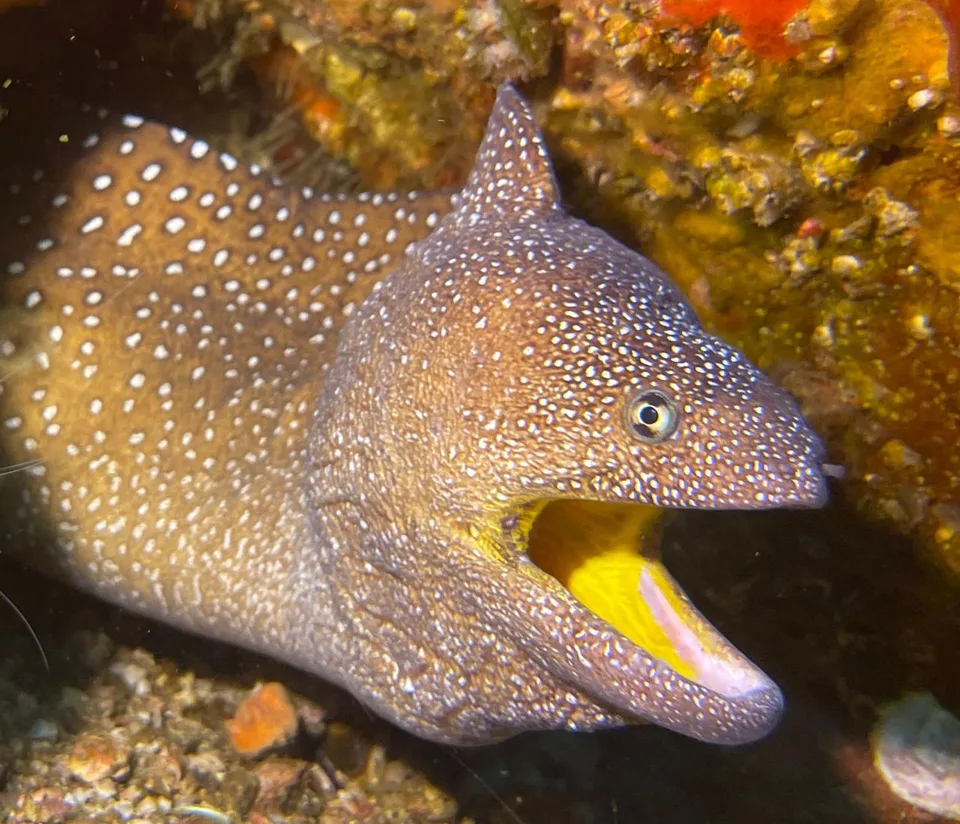
Generally solitary and mostly nocturnal. It spends the day with its head protruding from a crevice and becomes more active at night to search for prey. It may keep its mouth open to ventilate its gills; this is not necessarily a threat.
Carnivore; it feeds mainly on small reef fish and crustaceans, and can also capture cephalopods.
Reproduction
Oviparous
Identification marks
Robust moray eel with a dark brown to black body, densely covered with small pale yellow, cream, or white spots, resembling the plumage of a guinea fowl. The head is often lighter or yellowish, with visible pale spots.
Similar species
May be confused with other spotted Gymnothorax morays of the Indo-Pacific. Confirm the numerous small pale spots on the dark body and the often pale yellow head; species with large spots, networks of lines, or branched black snowflake-like markings are different.
Approach rules
Observe calmly without blocking its retreat. Keep hands, devices and equipment out of the crevice; do not touch, feed, provoke or attempt to handle the animal. If possible, maintain a respectful distance of approximately 2 to 3 m and avoid repeated flashes directed at its face.
Protection
Classified globally in the category “Least Concern” on the IUCN Red List. It is not listed under CITES. Protect reef habitat and avoid collection or disturbance, particularly in marine protected areas.