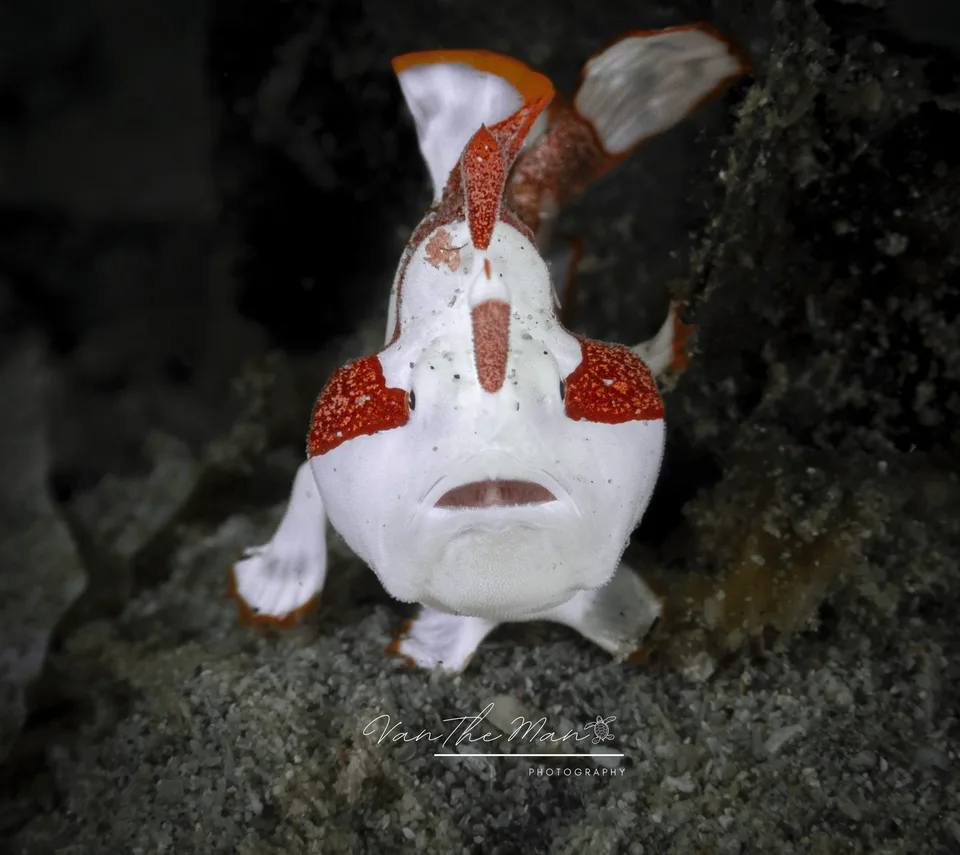
Typically found in shallow waters, often among coral reefs and rocky substrates.
Distribution
Found in the Indo-Pacific region, including areas around the Great Barrier Reef and the Coral Triangle.
Conservation status
Least Concern
Edibility
Edible, but very small and not generally targeted for food. It is best left undisturbed as a reef wildlife species.
Danger level
Harmless
Usual observation depth
3–15 m
Behaviour
Generally solitary, sedentary, and highly cryptic. It waits motionless for its prey and uses a small lure on its first dorsal spine to attract them within striking range.
Observation zones
Reef, lagoon, rubble slope, sponge and soft coral gardens; sometimes on artificial reef structures.
Diet
Ambush predator feeding mainly on small fish and crustaceans. It can rapidly swallow its prey thanks to its large mouth.
Reproduction
Oviparous
Identification marks
Stout, globular frogfish, with a very large upward-oriented mouth, limb-like pectoral fins and a short first dorsal spine bearing a lure. Coloration is highly variable, often yellow, orange, red, brown, black or pale, with warty skin outgrowths and contrasting spots or marbling edged in dark.
Similar species
Often confused with other frogfishes of the genus Antennarius with variable coloration, notably the painted frogfish (A. pictus) and the giant frogfish (A. commerson). Color alone is not reliable; compare skin texture, pattern, lure shape, and fin characteristics. Clear photographs and regional guides facilitate confirmation.
Approach rules
Approach slowly without touching it or blocking its passage. Keep a respectful distance of approximately 1 m, avoid repeated flashes at very close range, and never feed or move the animal for a photograph.
Protection
Globally assessed as a Least Concern species on the IUCN Red List. No CITES listing is known. Protect reef habitat and avoid collection or disturbance.