Coastal waters, often found in shallow bays and estuaries.
Distribution
Found in the tropical and subtropical waters of the Atlantic and Indo-Pacific regions.
Conservation status
Least Concern
Edibility
Edible, but not recommended: it is an Endangered species and is listed under CITES Appendix II. Avoid consumption and choose sustainable alternatives.
Culinary quality / 5
3
Danger level
Caution
Usual observation depth
5–40 m
Behaviour
Generally solitary or observed in small groups; may gather seasonally or at feeding sites. Primarily active during the day, but may also feed at night. It often swims above the bottom and may leap out of the water.
Observation zones
Reef, reef flat, lagoon, sandy bottom, seagrass bed, channel, estuary and occasionally open water near reefs.
Diet
Mainly benthic invertebrates, especially bivalve mollusks, gastropods, crustaceans and worms; it also consumes small fish. Its dental plates crush hard shells.
Reproduction
Ovoviviparous
Identification marks
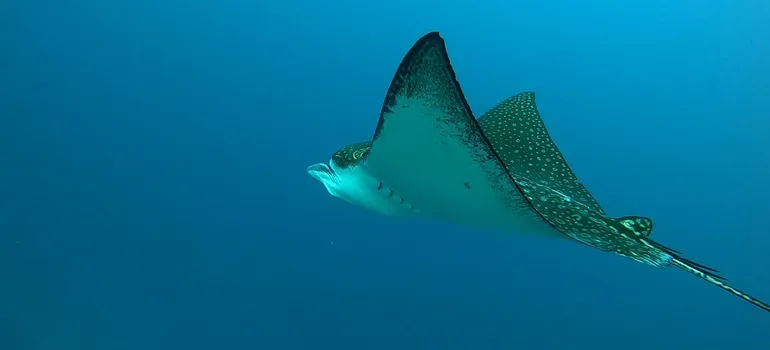
Large eagle ray with a broad, diamond-shaped disc, dark blue to black and covered with distinct white or pale blue spots. Long whip-like tail, protruding duckbill-shaped snout, and pale ventral surface.
Similar species
Often confused with other spotted eagle rays. The Atlantic leopard eagle ray, Aetobatus narinari, occurs in the Atlantic rather than the western Indo-Pacific. Aetobatus laticeps is present in parts of the Indian Ocean; reliable identification may require the location and examination by a specialist, as the spot patterns overlap.
Approach rules
Observe it calmly from the side, keep at least 3 m away, and never block its path or pursue it. Do not touch the ray or its tail, which may bear venomous spines. Avoid flash photography whenever possible, and never feed it.
Protection
IUCN: Endangered (EN). Listed in CITES Appendix II; international trade is regulated. Declines are linked to fishing pressure, bycatch and habitat degradation.