Coastal waters, often found in shallow bays and estuaries.
Distribution
Found in tropical and subtropical waters worldwide.
Conservation status
Least Concern
Edibility
Edible, but consumption is not recommended: this Vulnerable ray is affected by fishing pressure. Choose sustainable alternatives and follow applicable local guidance.
Culinary quality / 5
3
Danger level
Caution
Usual observation depth
10–60 m
Behaviour
Generally solitary or observed in small groups. Mainly active at night, it often rests during the day on sandy bottoms, under overhangs, or near reefs. It may be shy, but can become accustomed to heavily visited sites.
Observation zones
Reef, reef slope, lagoon, sand and passes; occasionally deeper waters offshore of the reef.
Diet
Feeds mainly on bottom-dwelling bony fish, crustaceans and cephalopods, detected notably through electroreception and sense of smell.
Reproduction
Viviparous
Identification marks
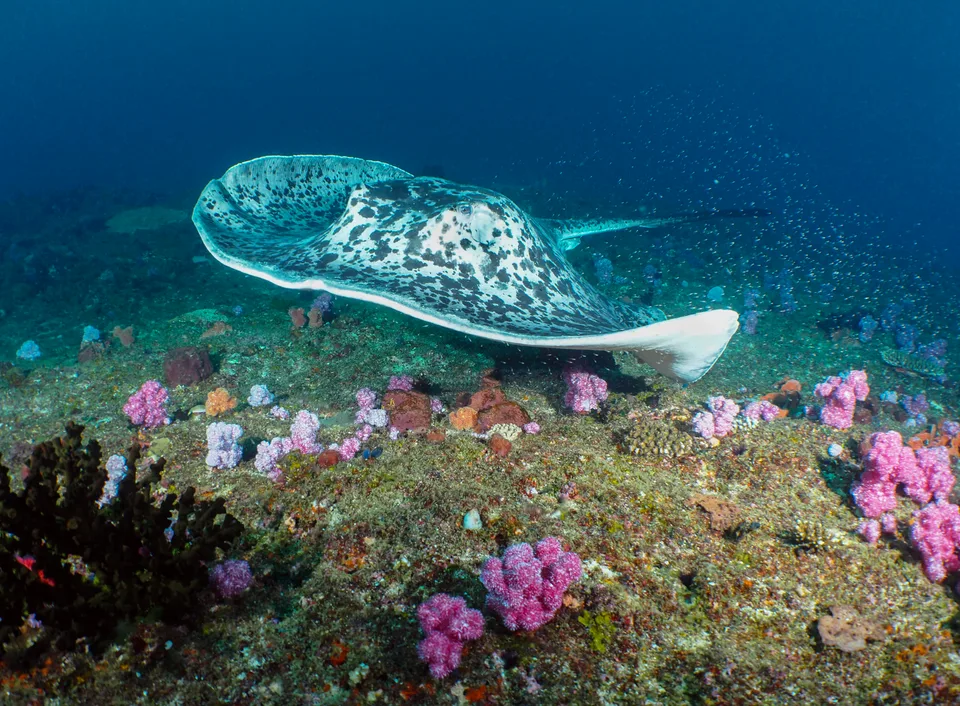
Very large oval stingray, with a broad head and a relatively short, thick tail bearing venomous spines. The upper surface is brownish-grey to dark brown, covered with numerous pale blue or whitish spots and irregular dark markings; the underside is pale. Adults may become generally darker.
Similar species
It can be confused with the blue-spotted ribbontail ray (Taeniura lymma), which is much smaller and has a long striped tail, or with blue-spotted rays (Neotrygon spp.), which are also markedly smaller. Its exceptional size, short, thick tail, and dark spots among the pale spots distinguish it.
Approach rules
Observe it calmly from the side, at a respectful distance, without blocking its path. Do not touch it, pursue it, position yourself above it, or corner it; stay clear of its tail and venomous spines. Do not use a flash at close range and never feed rays.
Protection
Classified as Vulnerable globally on the IUCN Red List. It is primarily threatened by targeted and incidental fishing as well as habitat degradation. It is not currently listed in the CITES appendices.