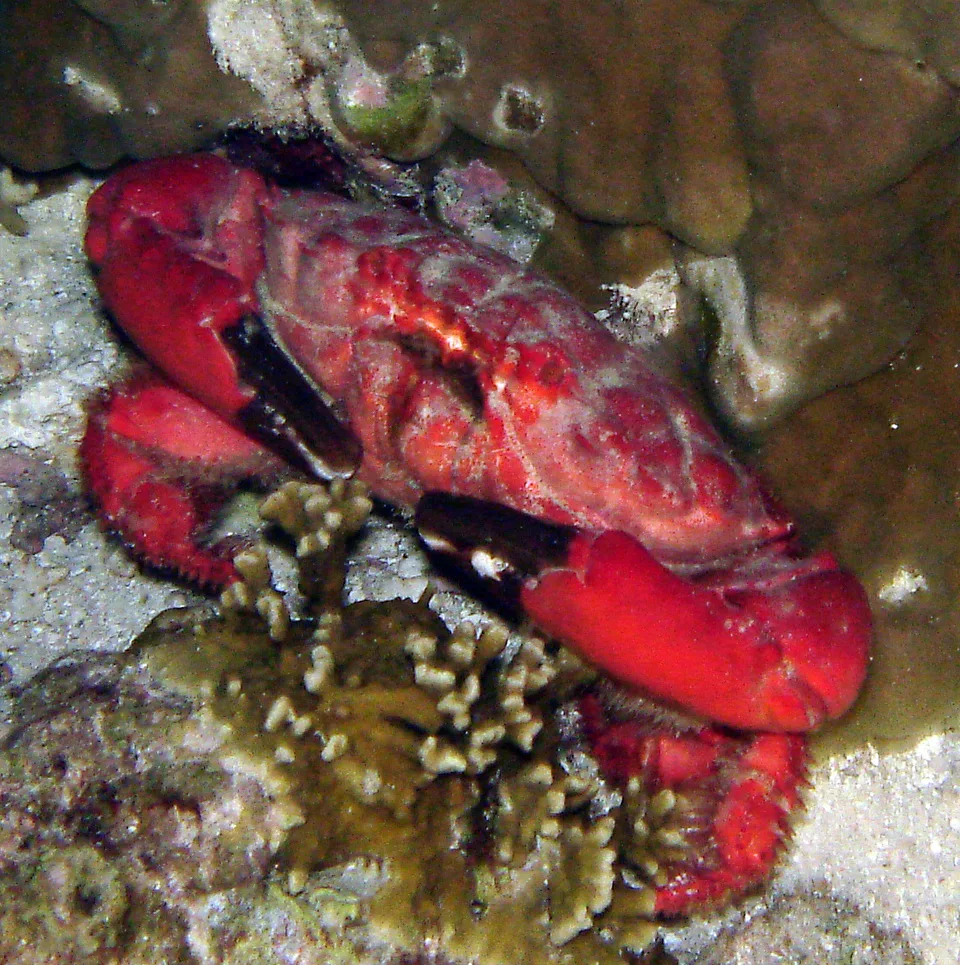
Typically found in coral reefs and rocky substrates.
Distribution
Found in the Indo-Pacific region.
Conservation status
Least Concern
Edibility
Not recommended: like other xanthid crabs, it may accumulate dangerous marine toxins that are not necessarily destroyed by cooking.
Danger level
Caution
Usual observation depth
1–25 m
Behaviour
Usually solitary, cryptic and mainly nocturnal. It shelters by day under boulders, in crevices and among coral rubble.
Observation zones
Reef, rocky reef flats, coral rubble, coarse sand near reefs and beneath boulders.
Diet
An omnivore and opportunistic predator, likely feeding on small benthic invertebrates, molluscs, crustaceans, polychaete worms, algae and carrion.
Reproduction
Oviparous
Identification marks
Broad oval, strongly granular carapace with toothed anterolateral margins; very robust, unequal claws. Colour is variable, often greenish-brown to reddish-brown with a mottled appearance.
Similar species
It can be confused with other Etisus species and xanthid crabs. Etisus laevimanus generally has a smoother carapace; reliable identification requires examination of the granulation, lateral teeth and claw shape.
Approach rules
Observe without touching it or dislodging it from its shelter. Keep hands away from the claws, avoid close-range flash, and never feed or handle it.
Protection
No known CITES listing and no published global IUCN assessment specific to this species. Respect reef-protection rules and avoid collecting it.