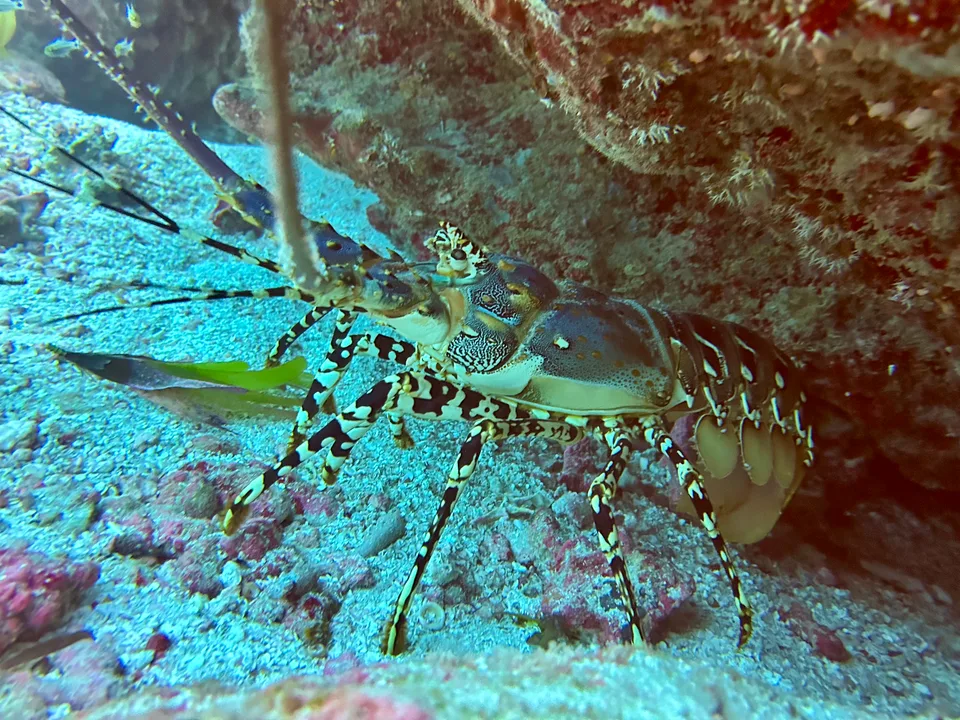
Found in rocky or coral reefs, often hiding in crevices.
Distribution
Widespread in tropical and subtropical waters around the world.
Conservation status
Least Concern
Edibility
Highly regarded edible lobster. Consume only specimens obtained through responsible, lawful sources; cook thoroughly and avoid eating spoiled or improperly stored shellfish.
Culinary quality / 5
5
Danger level
Caution
Usual observation depth
1–20 m
Behaviour
Generally solitary and discreet during the day, it shelters in holes and under overhangs. Primarily nocturnal, it emerges to feed at night; several individuals may be found close together when shelters are plentiful.
Observation zones
Coral reef, rocky reef, reef flat, lagoon, seagrass bed, sandy and detrital bottoms; most often in crevices, under overhangs or beneath coral heads.
Diet
An opportunistic omnivore and scavenger, it feeds mainly on mollusks, crustaceans, worms and other benthic invertebrates, as well as carrion and some plant matter.
Reproduction
Oviparous
Identification marks
Large spiny lobster lacking claws, with very long banded antennae. The body is blue-green to olive, heavily adorned with pale spots and dark transverse bands on the abdomen; the legs are distinctly striped.
Similar species
May be confused with the painted spiny lobster (Panulirus versicolor) and other Panulirus species. P. ornatus is generally larger and has a highly ornate greenish body, prominent dark transverse abdominal bands, and striped legs; P. versicolor is usually a brighter blue with very conspicuous light bands.
Approach rules
Observe calmly without touching, trapping, handling, or blocking the animal’s return to its shelter. Keep approximately 1 to 2 m away when possible, avoid or limit flash, and never feed it.
Protection
Classified as “Least Concern” by the IUCN globally. It is not listed under CITES; sustainable exploitation and the protection of reefs and nursery habitats are recommended.