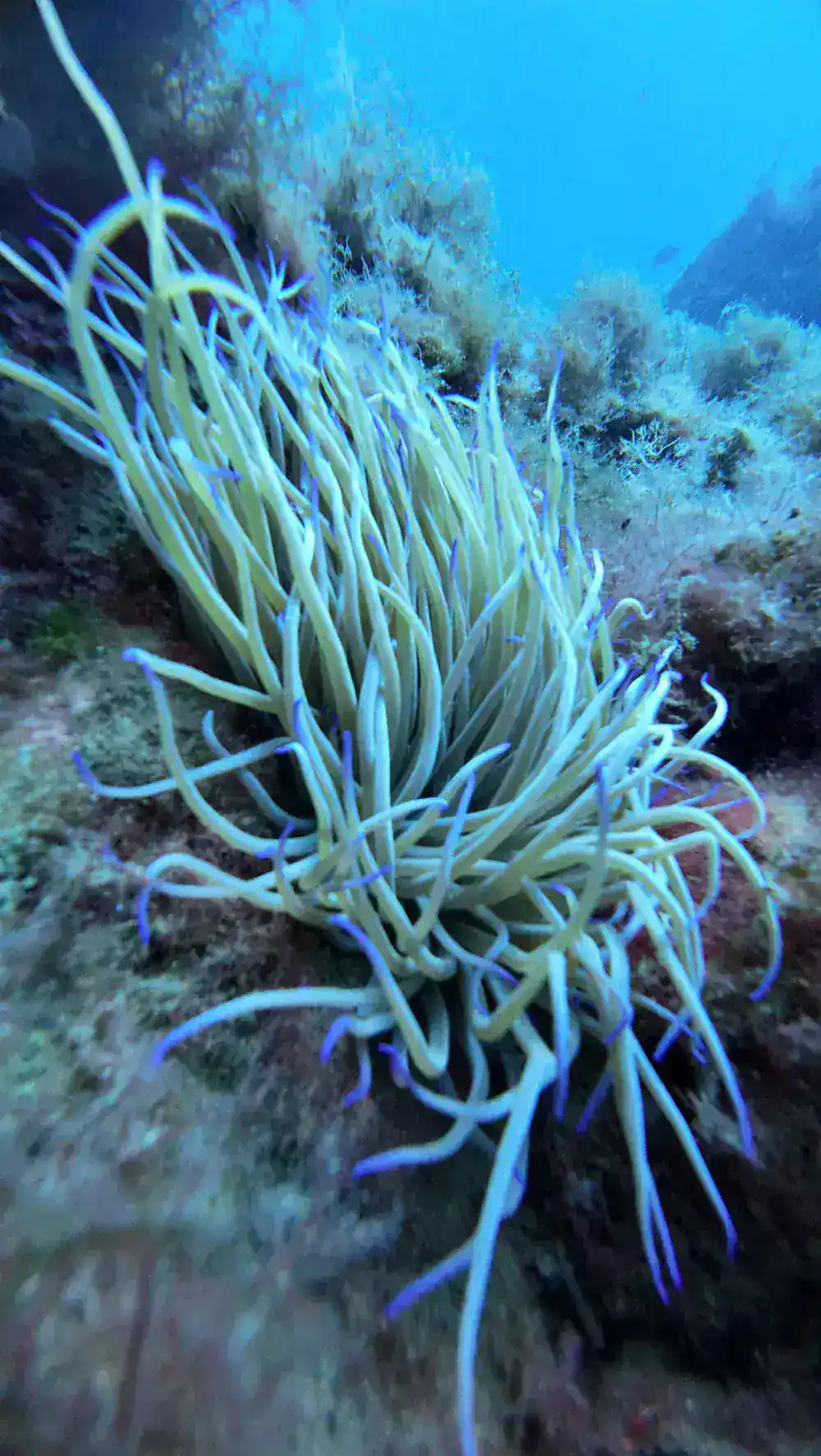
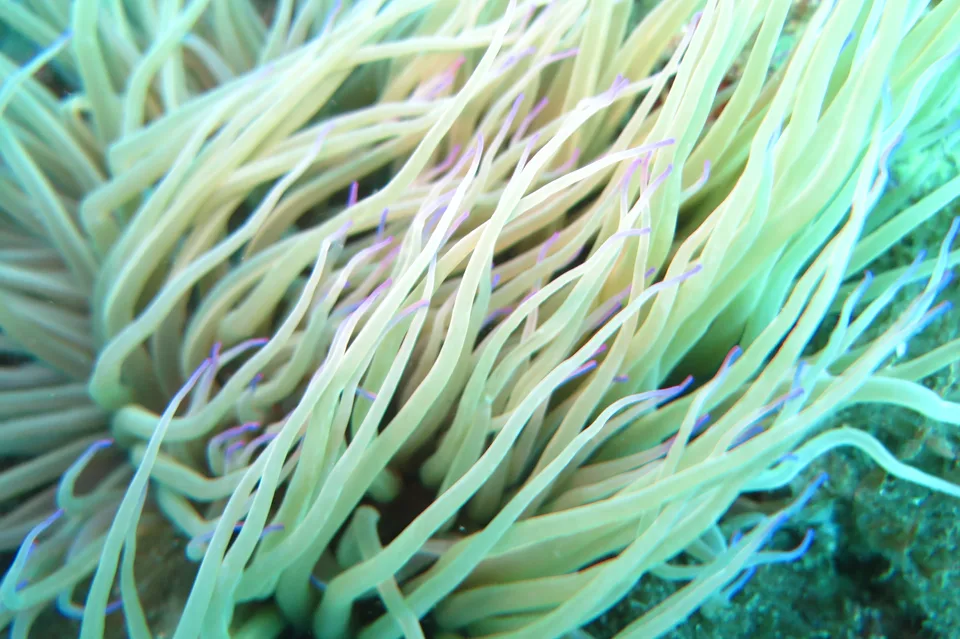
Shallow, well-lit rocky coasts, tide pools, crevices and seagrass-associated hard substrate; often in wave-exposed areas.
Distribution
Northeastern Atlantic and Mediterranean Sea, from the British Isles southward to the Iberian Peninsula and northwest Africa, including the Mediterranean.
Conservation status
Not Evaluated
Edibility
Edible and locally eaten, notably as fried sea anemones in parts of Spain. Consume only when correctly identified and properly prepared; its stinging cells can irritate bare skin.
Culinary quality / 5
4
Danger level
Caution
Usual observation depth
0–15 m
Lifespan (years)
0
Behaviour
A sessile, usually solitary anemone that remains attached to rock. Its long tentacles are generally extended in daylight to obtain light for symbiotic algae and to capture prey; it may contract when disturbed or exposed at low tide.
Observation zones
Rocky reef, tide pool, rocky wall, crevice, shallow seagrass edge and sheltered hard-bottom areas.
Diet
Mixotrophic: gains energy from symbiotic photosynthetic algae (zooxanthellae) and captures small zooplankton, crustaceans and other small animals with stinging tentacles.
Reproduction
Oviparous
Identification marks
Broad oral disc with numerous long, flowing green to grey-green tentacles, usually ending in conspicuous violet or purple tips. Tentacles are not readily withdrawn into the body.
Similar species
May be confused with other large Mediterranean anemones, especially Condylactis aurantiaca. A. viridis is characterized by its many slender, green, typically purple-tipped tentacles. The name Anemonia sulcata is an older synonym often encountered in guides.
Approach rules
Observe without touching or poking. Keep buoyancy controlled and avoid fin contact with the substrate. Do not feed it; avoid flash photography at very close range and allow space for other animals living among its tentacles.
Protection
Not listed in CITES. No global IUCN assessment is currently known; collection or disturbance should be avoided in marine protected areas and where site-specific rules apply.