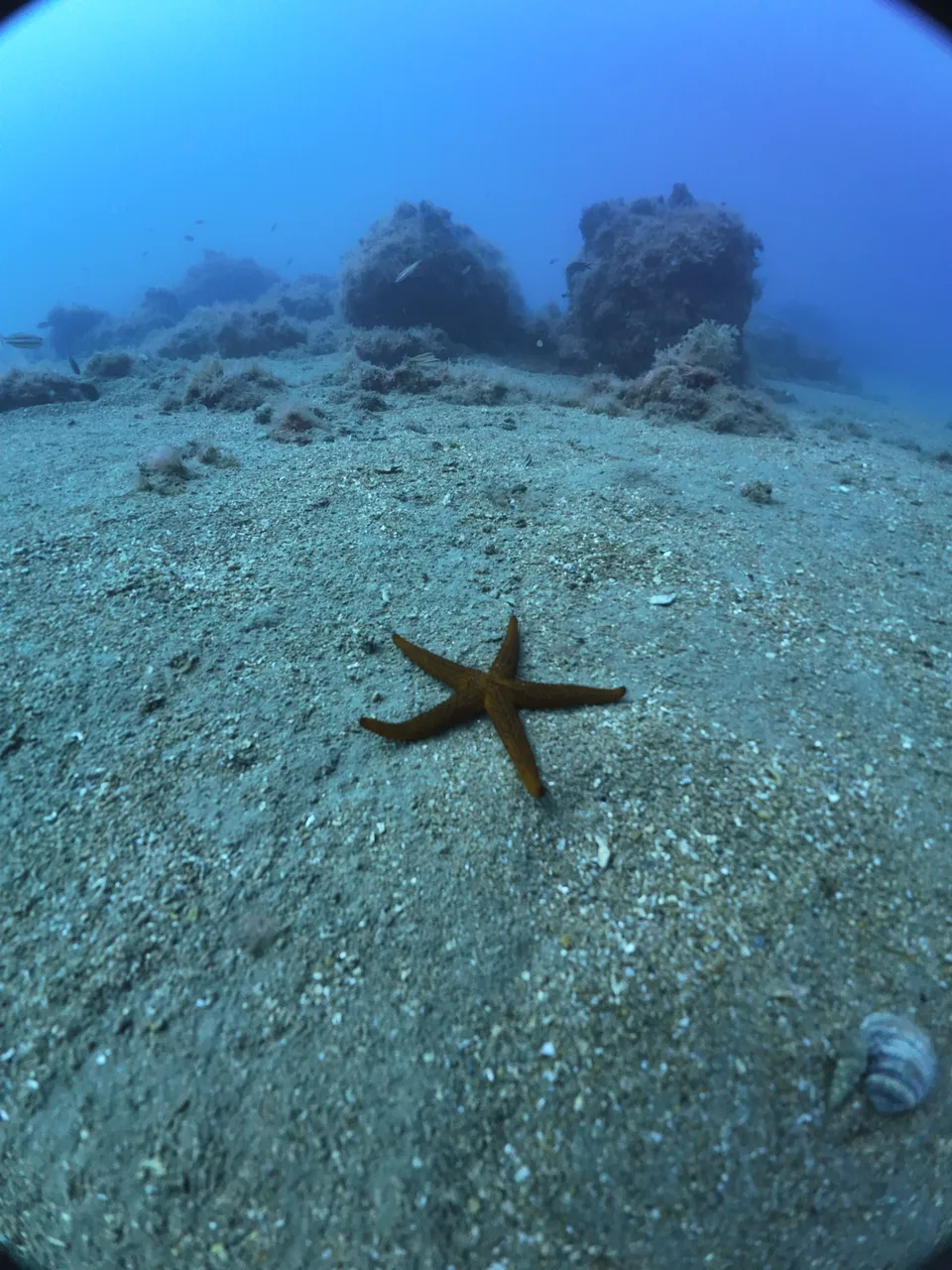
Found in shallow coastal waters, often on rocky substrates.
Distribution
Commonly found in the North Atlantic and North Pacific Oceans.
Conservation status
Least Concern
Edibility
Not a food species; culinary use is undocumented and consumption is not recommended.
Danger level
Harmless
Usual observation depth
?–20 m
Behaviour
Generally solitary and slow. It is most active while foraging and often remains hidden under rocks during the day or at low tide. It can regenerate lost arms.
Observation zones
Rocky reef, intertidal pool, seagrass bed, algae-covered rock, shallow hard bottom and sheltered crevices.
Diet
An opportunistic omnivore and scavenger, it consumes algal films, detritus, and small sessile or slow-moving invertebrates.
Reproduction
Oviparous
Identification marks
Small flattened pentagonal star, with five very short, broad and rounded arms, and a large central disc. The upper surface is relatively smooth to finely granular, generally brown, olive, grey or greenish, often marbled.
Similar species
May be confused with other small Asterina species. Asterina gibbosa normally has five short arms and a broadly pentagonal shape; reliable identification of closely related species may require specialist examination. It is easily distinguished from the common starfish Asterias rubens by its much shorter arms and the absence of prominent spines on the arms.
Approach rules
Observe without touching, lifting, or turning over the animal. Keep fins and equipment away from the bottom, do not move stones, do not feed it, and avoid using flash at very close range.
Protection
Not listed under CITES. No global IUCN assessment is currently established for this species; avoid unnecessary collection and comply with local conservation regulations.