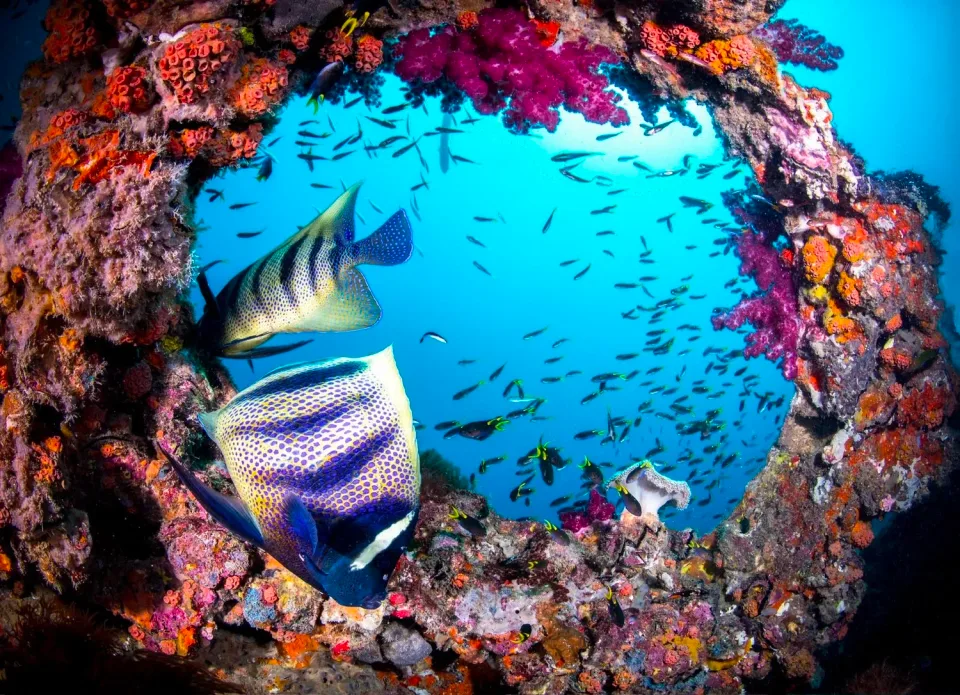
Coral-rich tropical reefs, including lagoons, reef slopes, channels and sheltered areas with crevices and caves.
Distribution
Eastern Indian Ocean and western Pacific, from the Andaman Sea and Indonesia eastward to Papua New Guinea and the Solomon Islands, north to southern Japan and south to northern Australia.
Conservation status
Least Concern
Edibility
Edible, but it is not a preferred food fish in many areas. Reef fish can carry ciguatera toxins; avoid consumption where ciguatera risk is known.
Culinary quality / 5
3
Danger level
Harmless
Usual observation depth
10–40 m
Lifespan (years)
0
Behaviour
Usually seen alone or in pairs. It is mainly diurnal, remains close to reef structure, and juveniles are particularly secretive among crevices and sheltered coral areas.
An omnivorous reef feeder that eats mainly sponges and tunicates, supplemented by algae and other attached benthic invertebrates.
Reproduction
Oviparous
Identification marks
Large, deep-bodied angelfish with a yellowish to olive face and body marked by six broad dark vertical bands. The posterior body and tail are yellow, while the fins often show blue edging or spotting.
Similar species
May be confused with other Pomacanthus angelfishes. Pomacanthus imperator has many narrow horizontal blue and yellow lines rather than six broad vertical dark bands. Pomacanthus semicirculatus has curved blue lines and lacks the clear six-banded adult pattern.
Approach rules
Approach slowly and calmly without blocking its route to reef cover. Keep a respectful distance, avoid touching coral or pursuing the fish, do not feed it, and avoid repeated close flash photography.
Protection
Assessed globally as Least Concern on the IUCN Red List. Not listed in the CITES Appendices. Reef habitat protection and responsible observation are advisable.