Found in deep ocean waters, often near the seabed.
Distribution
Widespread in tropical and subtropical oceans.
Conservation status
Data Deficient
Edibility
Not suitable for consumption. This is a highly venomous sea snake; do not handle, catch or eat it.
Danger level
Dangerous
Usual observation depth
?–30 m
Behaviour
Generally solitary and mainly active during the day, although it may also move and hunt at night. It regularly surfaces to breathe and is not usually aggressive unless threatened, handled, or trapped.
Observation zones
Sandy and muddy flats, shallow coastal bottoms, estuaries, mangroves, sheltered bays and reef margins.
Diet
Mainly small bottom-dwelling fish, including eels and goby-like fish; it may also catch other small fish.
Reproduction
Viviparous
Identification marks
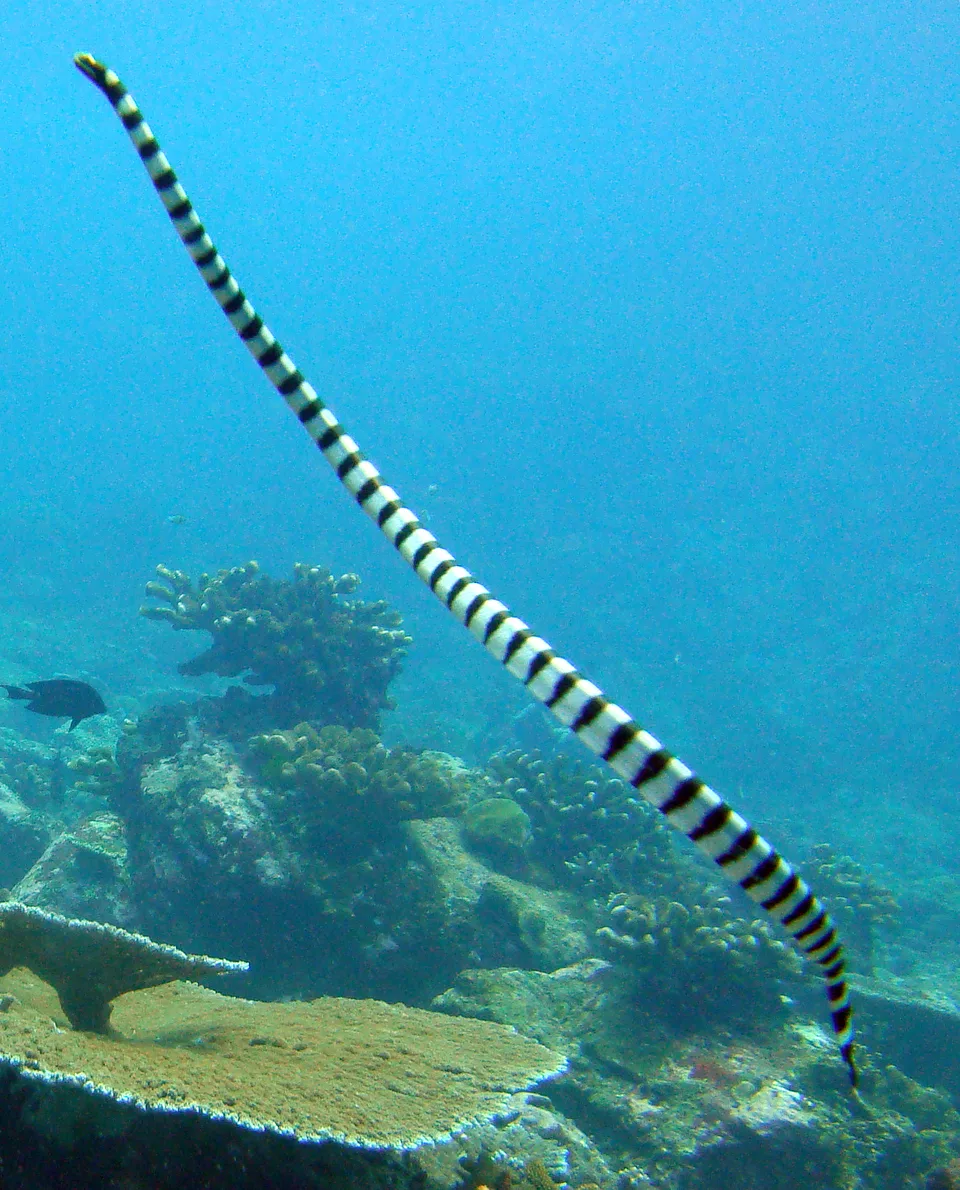
Long marine snake with a laterally compressed body and a paddle-shaped tail. The body is generally pale gray, olive or yellowish, with numerous narrow, dark transverse bands, often less distinct in older individuals.
Similar species
May be confused with other striped sea snakes of the genus Hydrophis. The yellow-lipped sea krait (Laticauda colubrina) has broader and more distinct black bands, a very flattened tail, and large ventral scales adapted for terrestrial movement; Hydrophis cyanocinctus is entirely marine.
Approach rules
Observe calmly from at least 3 m away. Never touch, restrain, pursue, corner, or feed the animal. Let it surface freely to breathe. Avoid repeated flashes at close range, especially if it displays avoidance or defensive behavior.
Protection
Globally assessed as “Least Concern” by the IUCN. It is not listed under CITES. Avoid collection, handling and disturbance; local protection measures may apply.