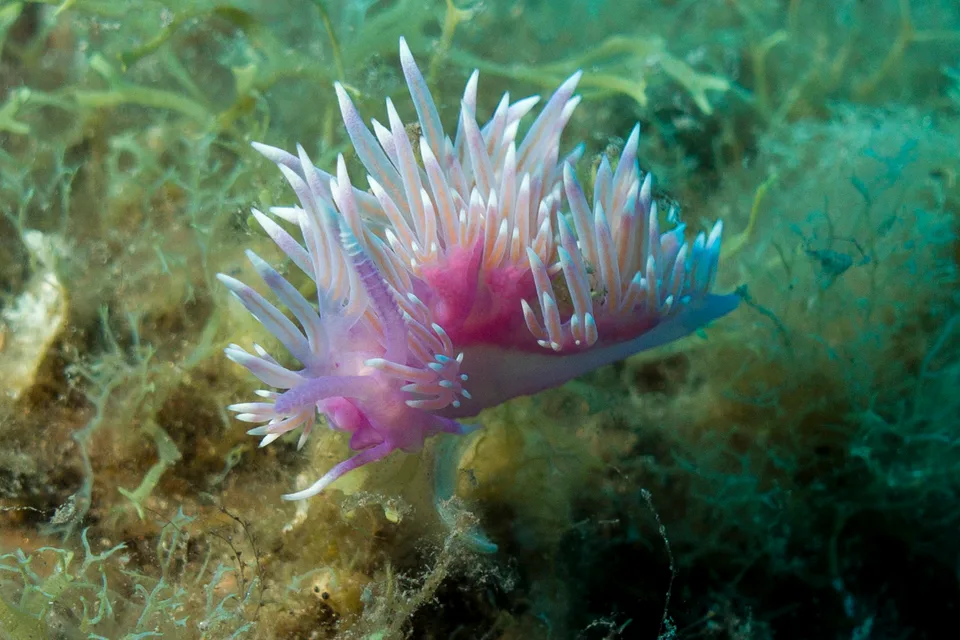
Found in shallow waters, often on rocky substrates and among algae.
Distribution
Widespread in the North Atlantic and Mediterranean Sea.
Conservation status
Least Concern
Edibility
Not used as food. This very small nudibranch is unsuitable for consumption; do not collect it.
Danger level
Harmless
Usual observation depth
5–25 m
Behaviour
Generally solitary and active during the day. It crawls slowly over hydroid colonies to feed and may be observed near other individuals during reproduction.
Observation zones
Rocky reef, reef drop-off, hard substrate near seagrass beds and hydroid-covered structures.
Diet
Specialized predator of hydroids, particularly species of the genus Eudendrium and related hydrozoans.
Reproduction
Oviparous
Identification marks
Slender aeolid nudibranch with a translucent violet to purple body, bearing numerous red-orange cerata often tipped with white and smooth purple rhinophores. The cerata are arranged in distinct groups on the back.
Similar species
It can be confused with other purple aeolids, notably Flabellina lineata and Edmundsella pedata. Flabellina lineata bears clearly visible longitudinal white lines on the body and rhinophores, whereas E. pedata usually has more distinctly grouped clusters of cerata, in a hand-like shape.
Approach rules
Observe without touching, moving, or collecting the animal or its hydroid prey. Maintain good buoyancy to avoid any contact with the substrate. Use moderate lighting or flash; never feed wildlife.
Protection
No specific global protection status is known. Avoid collection and disturbance, and respect the rules of protected areas and sites when applicable.