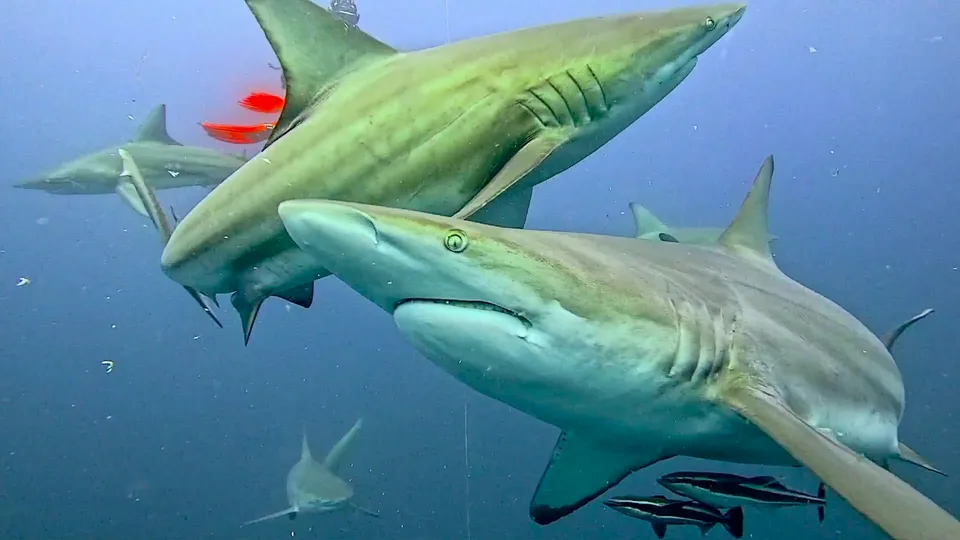
Coastal waters, often found in shallow areas near the shore.
Distribution
Found in temperate and tropical waters worldwide.
Conservation status
Least Concern
Edibility
Its meat is edible and has been sold fresh, frozen, salted or dried, but this Endangered shark is vulnerable to fishing pressure. Avoid consumption where possible; shark meat may also contain elevated mercury.
Culinary quality / 5
3
Danger level
Caution
Usual observation depth
20–65 m
Lifespan (years)
35
Behaviour
Generally solitary or observed in small, loosely structured groups. It is mainly active at night and rests or moves slowly near the bottom during the day. Adults may undertake seasonal movements, while juveniles remain in coastal nurseries.
Observation zones
Sandy flats, coastal reefs, reef edges, bays, channels, offshore shoals and occasionally wrecks; mainly over sandy or mixed bottoms rather than in open blue water.
Diet
Primarily bony fish, including bottom-dwelling fish, as well as rays, small sharks, cephalopods, and crustaceans.
Reproduction
Viviparous
Identification marks
Large, robust brownish-gray shark of the gray shark family, recognizable by its very tall, triangular first dorsal fin. This fin begins above or just behind the rear edge of the pectoral fins. The snout is moderately long and rounded, the eyes relatively large, the fin edges uniform and without visible black tips.
Similar species
Often confused with the dusky shark (Carcharhinus obscurus), whose first dorsal fin is generally lower and which has more oceanic tendencies. The bignose shark (Carcharhinus altimus) has a longer, more pronounced snout. Reliable identification may require careful examination of fin positions and body proportions.
Approach rules
Observe calmly from a respectful distance of at least 3 to 4 m and leave the shark a clear escape route. Do not touch, pursue, block its path, bait, feed, or use a flash at close range. Leave the water if it makes repeated close passes, suddenly adopts a different posture, or shows signs of agitation.
Protection
Assessed as Endangered globally on the IUCN Red List. International trade is regulated by CITES Appendix II. Protection and fishing regulations vary by country and region.