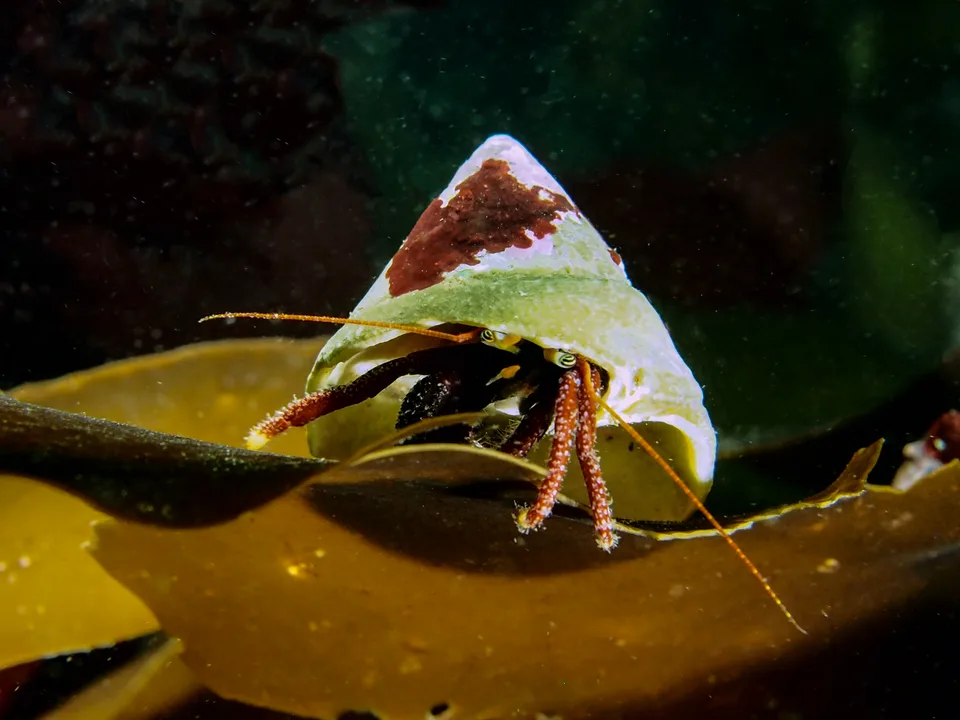
Found in sandy and rocky substrates in shallow coastal waters.
Distribution
Primarily found along the Pacific coast of North America.
Conservation status
Least Concern
Edibility
Technically edible, but it is very small and is not a practical or customary food species. Culinary quality is not well documented.
Danger level
Harmless
Usual observation depth
?–5 m
Behaviour
Generally solitary and mobile. It lives in an empty snail shell that it carries and into which it retreats when threatened. Individuals may gather near food or available shells.
Scavenger and omnivorous grazer; it consumes detritus, carrion, algae, organic particles and small invertebrates.
Reproduction
Oviparous
Identification marks
Small hermit crab with ambulatory legs distinctly banded in blue, often with pale and red-orange markings. The right claw is enlarged, and the soft abdomen remains hidden in a borrowed gastropod shell.
Similar species
It may be confused with other northeastern Pacific species of Pagurus, notably Pagurus hirsutiusculus and Pagurus granosimanus. Pagurus samuelis is recognized primarily by its distinctly blue-banded legs; reliable identification may require close examination of the texture of the claws, setae, and other anatomical details.
Approach rules
Observe without touching, lifting, or removing its shell. Keep hands and equipment out of its path, do not feed it, and avoid repeated flashes at close range.
Protection
Not listed under CITES, and no global IUCN Red List assessment is known. It is recommended to preserve the intertidal habitat and leave the animals and their shells in place.