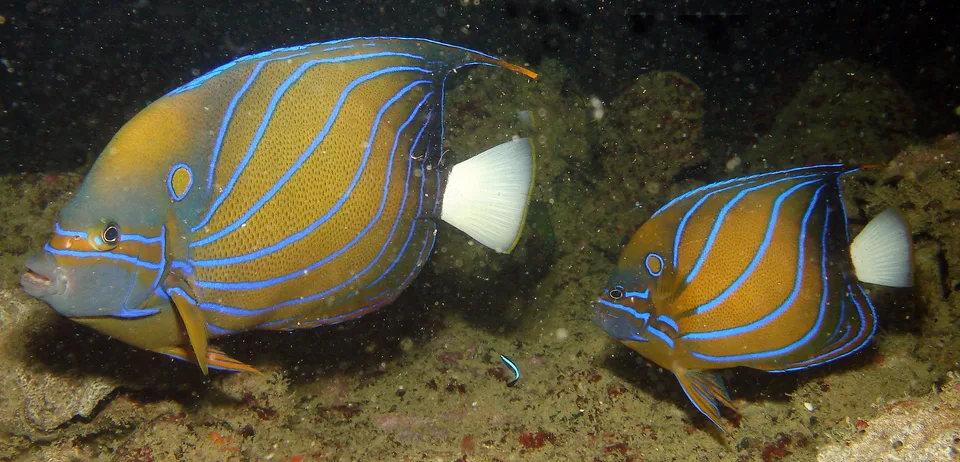
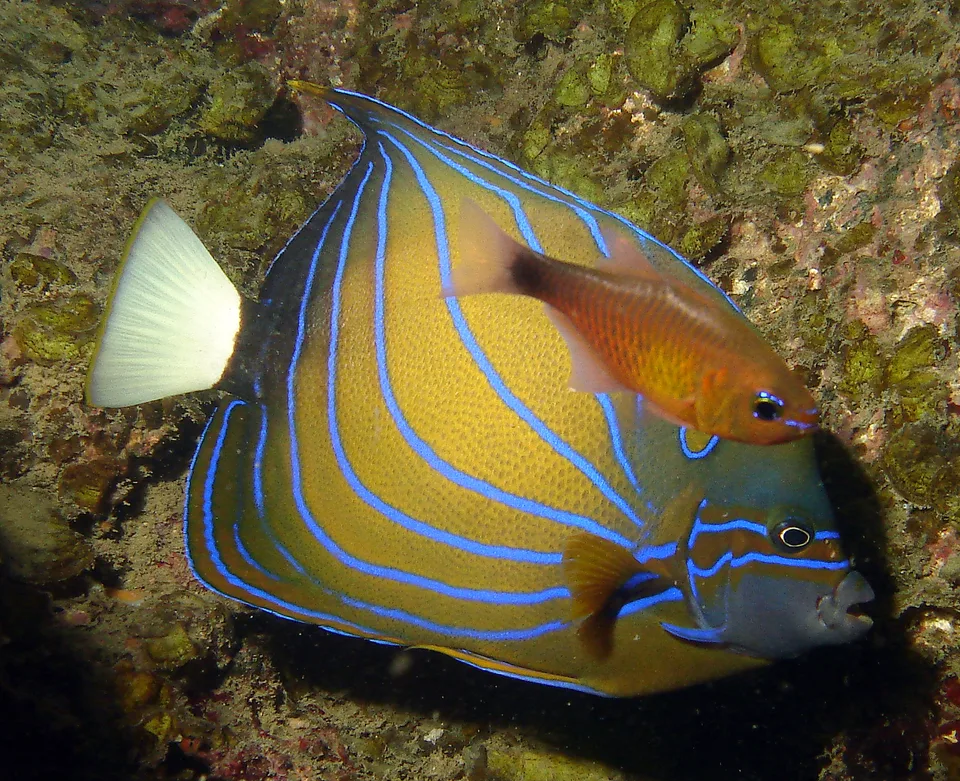
Widespread in the tropical waters of the Indo-Pacific region.
Conservation status
Least Concern
Edibility
Edible, but not generally recommended: large reef fish can carry ciguatera toxins in some areas. Consumption guidance should follow local public-health advice.
Culinary quality / 5
2
Danger level
Harmless
Usual observation depth
3–20 m
Lifespan (years)
16
Behaviour
Most often observed alone or in pairs. It is diurnal and generally wary, taking refuge in the reef structure when disturbed. Juveniles are more elusive and use small crevices.
Observation zones
Coral reef, rocky reef, lagoon, reef slope and sheltered reef channels; mainly around reef structures rather than in open water.
Diet
Feeds primarily on benthic sponges and tunicates, supplemented by algae and other organisms attached to the bottom.
Reproduction
Oviparous
Identification marks
Large angelfish with a deep body. Adults are yellowish brown to olive, with several curved electric-blue lines on the rear half of the body, a prominent blue ring above the operculum, and a yellow caudal fin. Juveniles are dark with curved pale-blue and white bands.
Similar species
May be confused with the emperor angelfish (Pomacanthus imperator), which has prominent blue and yellow horizontal stripes and a dark facial mask. The semicircle angelfish (Pomacanthus semicirculatus) has more blue lines on the body, but lacks the combination of a distinct blue opercular ring and a yellow tail in adults.
Approach rules
Approach slowly from the side, avoid blocking its access to a reef shelter and keep a respectful distance of approximately 2 to 3 m. Do not touch it, chase it, corner it or feed it. Avoid flash as much as possible, especially at close range.
Protection
Listed as Least Concern on the IUCN Red List. It is not listed in the CITES Appendices. Protect reef habitat and avoid collection or disturbance in marine protected areas and where local regulations apply.