Demersal species inhabiting rocky reefs, coralligenous bottoms, boulder fields, crevices and occasionally seagrass or mixed sand-and-rock bottoms.
Distribution
Eastern Atlantic, from the British Isles south to Senegal, including Macaronesian islands; also widespread in the Mediterranean and present in the Black Sea.
Conservation status
Least Concern
Edibility
Highly regarded food fish. Its flesh is edible and valued, but the venomous dorsal, anal and pelvic-fin spines can cause painful wounds during handling; remove spines carefully and cook thoroughly.
Culinary quality / 5
5
Danger level
Caution
Usual observation depth
20–200 m
Lifespan (years)
0
Behaviour
Usually solitary, sedentary and strongly camouflaged. It rests on the seabed by day and ambushes prey, becoming more active at dusk and at night.
Observation zones
Rocky reef, coralligenous reef, boulder field, ledge, crevice, cave entrance, wall, seagrass edge and mixed sand-rock bottom; occasionally around wrecks.
Diet
An ambush predator feeding mainly on small fishes, crustaceans and other benthic invertebrates.
Reproduction
Oviparous
Identification marks
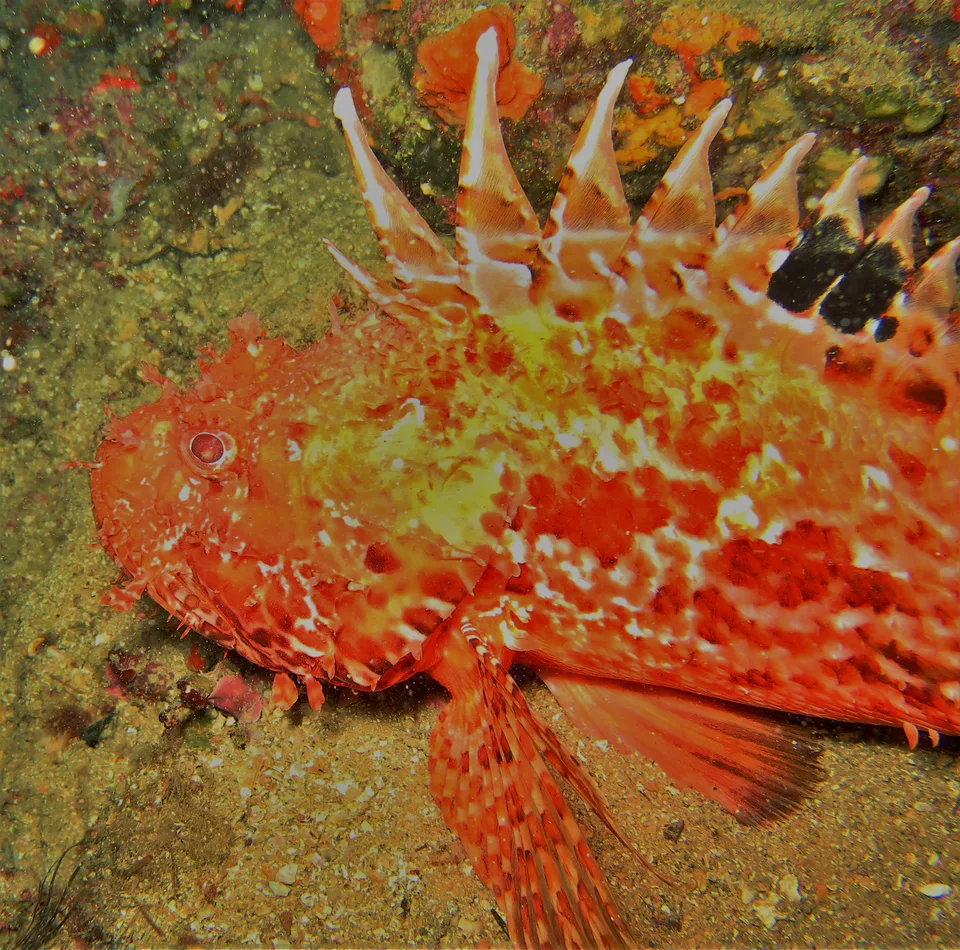
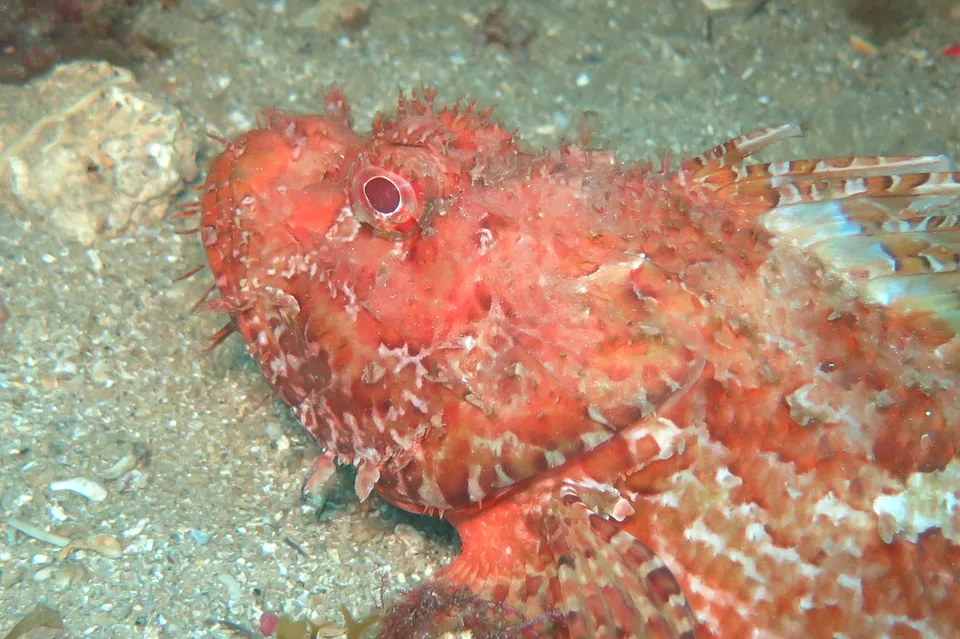
A robust, large-headed scorpionfish with a broad mouth, prominent bony head ridges and numerous fleshy skin flaps, especially above the eyes. Colour is highly variable but commonly red, pink, brown or mottled; it has a large spiny dorsal fin and conspicuous venomous fin spines.
Similar species
It can be confused with other Mediterranean scorpionfishes, especially Scorpaena porcus and Scorpaena notata. Scorpaena scrofa is generally larger and more robust, with more developed head appendages. Scorpaena notata is smaller and is characterized by a distinct dark spot on the rear part of the dorsal fin; colour alone is not reliable for identification.
Approach rules
Approach slowly without touching the bottom or the fish, and keep hands, knees and equipment clear of its fins. Maintain a respectful distance of about 1–2 m where possible. Avoid repeated close flash photography, never handle it, and do not feed wildlife.
Protection
IUCN: Least Concern (LC). Not listed in CITES. Follow protected-area rules and fisheries measures that apply at the observation or capture location.