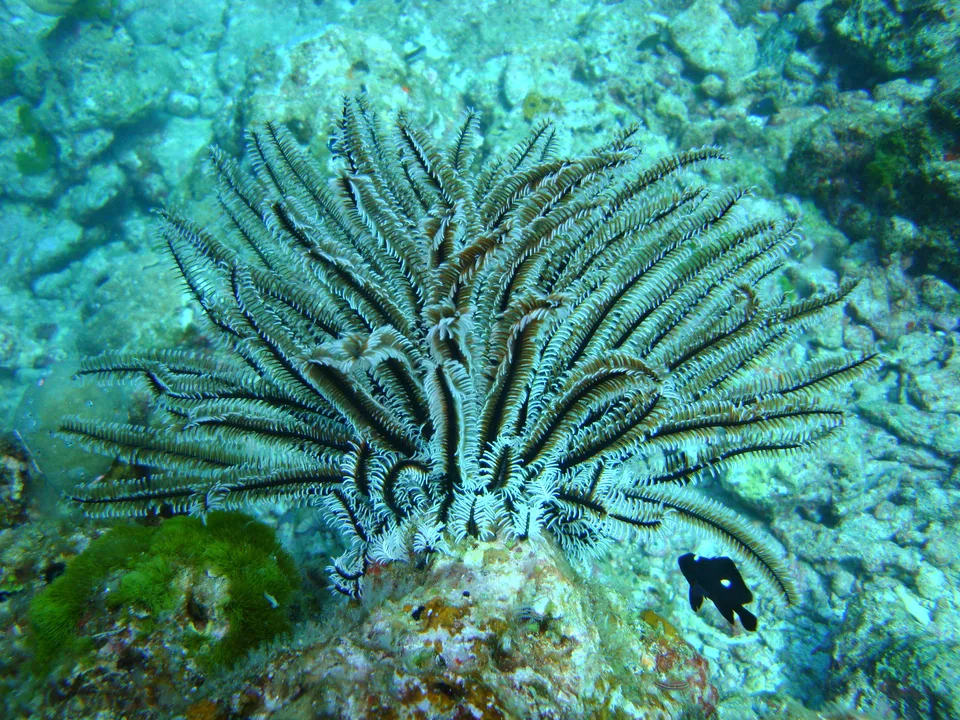
Found in shallow waters, often on coral reefs or rocky substrates.
Distribution
Widespread in tropical and subtropical oceans.
Conservation status
Least Concern
Edibility
Not normally eaten and has no documented culinary value. Do not collect animals encountered while diving.
Danger level
Harmless
Usual observation depth
10–50 m
Behaviour
Usually solitary, and most active when currents bring plankton. It can crawl, swim briefly by waving its arms, or attach to a support. Often more conspicuous at night or in shaded places.
Observation zones
Rocky reef, drop-off, wall, overhang, illuminated cave and coralligenous formations.
Diet
Suspension feeder: captures organic particles, phytoplankton and zooplankton with the pinnules on its arms.
Reproduction
Oviparous
Identification marks
A feather-like echinoderm, usually red to orange-red, with long branched arms bearing numerous pinnules. The oral surface faces upward while feeding; small cirri are used for anchoring.
Similar species
It may be confused with other Mediterranean feather stars, notably Antedon bifida and Leptometra celtica. Colour alone is unreliable; certain identification requires examination of the number and shape of the arms, pinnules and cirri.
Approach rules
Approach slowly without touching the arms or its support. Keep enough distance to avoid contact with fins or equipment. Limit repeated flash use, and never feed or move the animal.
Protection
No CITES listing is known for Antedon mediterranea. Its global IUCN status has not been established; follow general no-collection practices and respect marine habitats.