Edible and sometimes sold for food, but consumption carries a potential risk of ciguatera poisoning, especially from larger reef fish. Avoid eating fish from areas with known ciguatera risk.
Culinary quality / 5
2
Danger level
Harmless
Usual observation depth
3–30 m
Lifespan (years)
15
Behaviour
Most often observed alone, in pairs or in small groups. It is active during the day and frequently patrols along reefs while feeding. Juveniles may act as cleaner fish and remove parasites from other fish.
Observation zones
Coral reef, reef slope, isolated reef, rocky reef, shallow lagoon and, for juveniles, sometimes mangrove edges.
Diet
Omnivore feeding primarily on sponges, but also on ascidians, algae, bryozoans, hydroids and other sessile invertebrates.
Reproduction
Oviparous
Identification marks
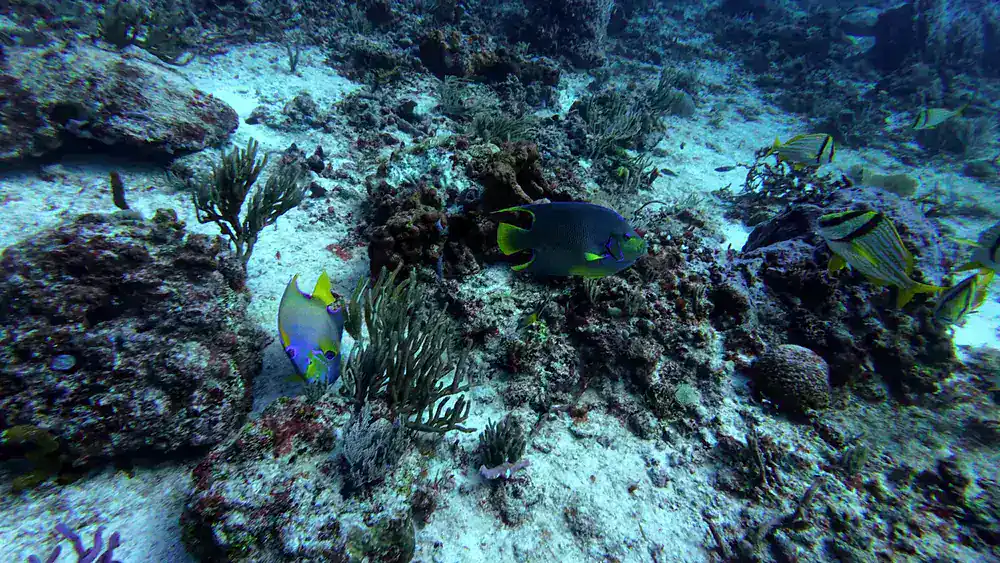
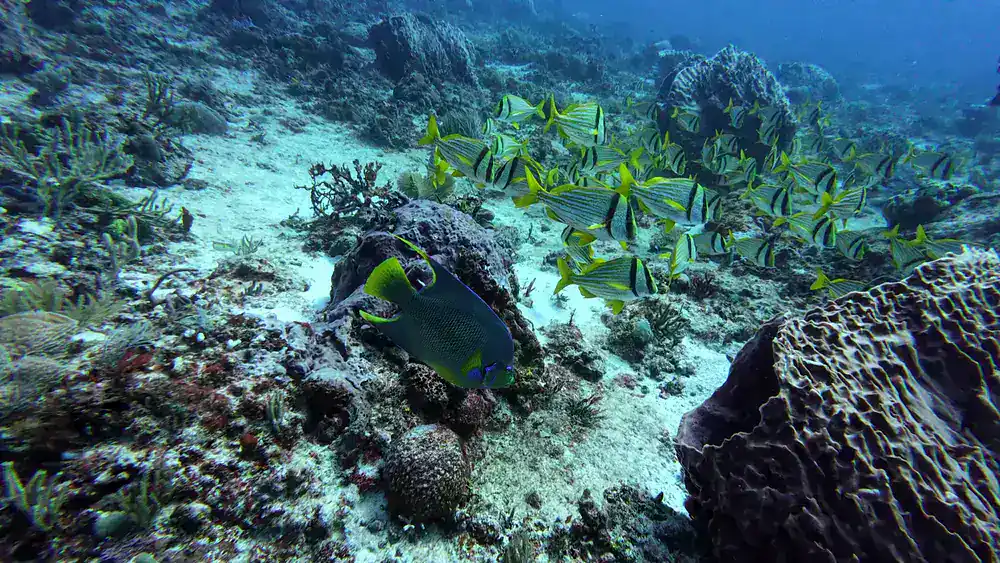
Large angelfish with a deep body, bright yellow to yellow-orange, with blue-edged scales, blue lips and a dark spot ringed in blue, or “crown,” on the forehead. Adults have elongated posterior rays on the dorsal and anal fins. Juveniles are dark blue with curved light-blue bars.
Similar species
Often confused with the blue angelfish (Holacanthus bermudensis), which is generally bluer and lacks the characteristic blue crown on the forehead. The two species can hybridize where their ranges overlap. Juveniles may resemble juvenile French angelfish (Pomacanthus paru), but those of the queen angelfish have curved blue bars rather than more vertical bands.
Approach rules
Approach slowly and calmly, without chasing or cornering the fish. Keep a respectful distance of several meters, do not block its path on the reef, do not touch or feed it, and avoid flash if it disturbs it.
Protection
IUCN Red List: Least Concern (LC). The species is not listed in the CITES Appendices. Protect reef habitats and mangroves, and comply with applicable local conservation measures.