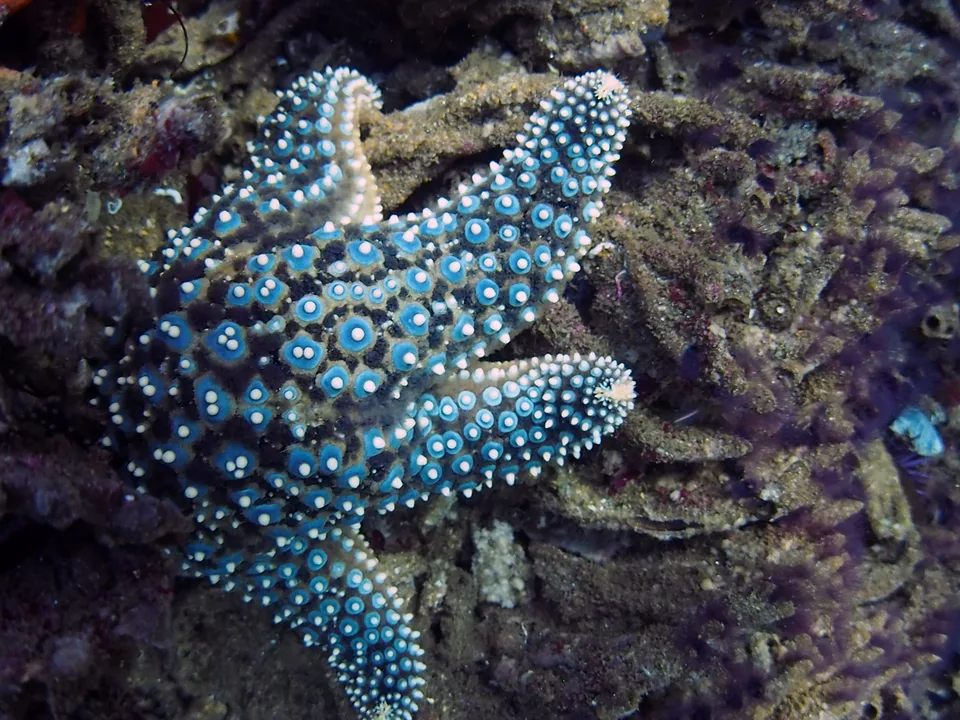
Found in sandy and muddy substrates on the ocean floor, often in shallow waters.
Distribution
Native to the Indo-Pacific region, including areas around the Great Barrier Reef.
Conservation status
Least Concern
Edibility
Edible and commercially valued as bêche-de-mer, but the species is vulnerable to overharvest; choose only demonstrably sustainable, legally sourced products.
Culinary quality / 5
4
Danger level
Harmless
Usual observation depth
3–30 m
Behaviour
Generally solitary and slow-moving. It lives mainly on the bottom, where it continuously feeds on sediments; its activity may increase at night.
Observation zones
Reef, reef flat, lagoon, sand and coral rubble.
Diet
Deposit feeder: it ingests sand and sediments from which it extracts organic detritus, bacteria, microalgae and other microorganisms.
Reproduction
Oviparous
Identification marks
Very large, stout and cylindrical sea cucumber, usually orange-brown to reddish-brown. The body is covered with large conical papillae resembling a pineapple, often with darker tips; the ventral surface bears tube feet.
Similar species
It can be confused with other large Thelenota species. Thelenota anax is generally larger, more grey-brown, and has papillae that are less distinctly pineapple-like. Thelenota rubralineata has conspicuous reddish longitudinal lines rather than the strongly conical papillae of T. ananas.
Approach rules
Observe without touching, lifting, or turning over the animal. Keep a respectful distance, avoid any contact with its body or the surrounding substrate, do not feed it, and avoid using flash at close range.
Protection
Classified as Vulnerable (VU) by the IUCN. The species is heavily exploited for the sea cucumber trade; careful management of harvesting, protection of reef habitats, and sustainable sourcing are important. It is not listed under CITES.