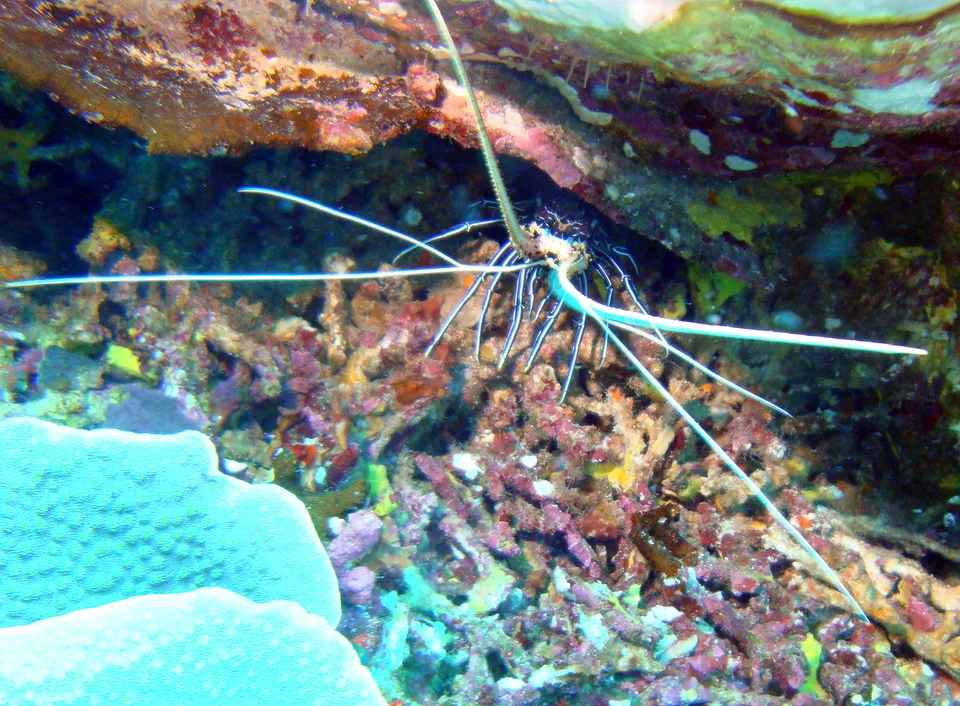
Found in the tropical and subtropical waters of the Atlantic Ocean
Conservation status
Least Concern
Edibility
Edible and highly regarded as seafood. Consume only from a safe, traceable source and follow applicable health advice, including local ciguatera-risk guidance where relevant.
Culinary quality / 5
5
Danger level
Caution
Usual observation depth
1–30 m
Behaviour
Generally solitary or observed in small groups sharing a shelter. Mainly nocturnal: it remains hidden in crevices during the day and searches for food on the reef at night. It can rapidly flee backwards thanks to its caudal fan.
Opportunistic omnivore and detritivore, feeding on mollusks, crustaceans, echinoderms, worms, carrion and other benthic invertebrates.
Reproduction
Oviparous
Identification marks
Large clawless spiny lobster, with extremely long, spiny antennae. The body is blue-green to dark green, with conspicuous pale or white spots on the carapace and broad, light transverse bands on the abdomen; the legs and antennae are distinctly banded.
Similar species
It can be confused with the ornate spiny lobster, Panulirus ornatus, or with other Indo-Pacific species of Panulirus. P. versicolor is distinguished by its characteristic light transverse bands on the abdomen and its pronounced pale spots on a blue-green carapace; examination of the color pattern and frontal spines is useful.
Approach rules
Observe calmly without blocking the crevice or escape route. Keep a respectful distance, do not touch the antennae or body, do not handle or feed it. Avoid using flash at close range, especially when it is sheltered.
Protection
Assessed globally as Least Concern on the IUCN Red List. It is not listed under CITES. Populations may nevertheless be affected by fishing pressure and reef degradation; prioritize sustainable and traceable sources as well as reef conservation.