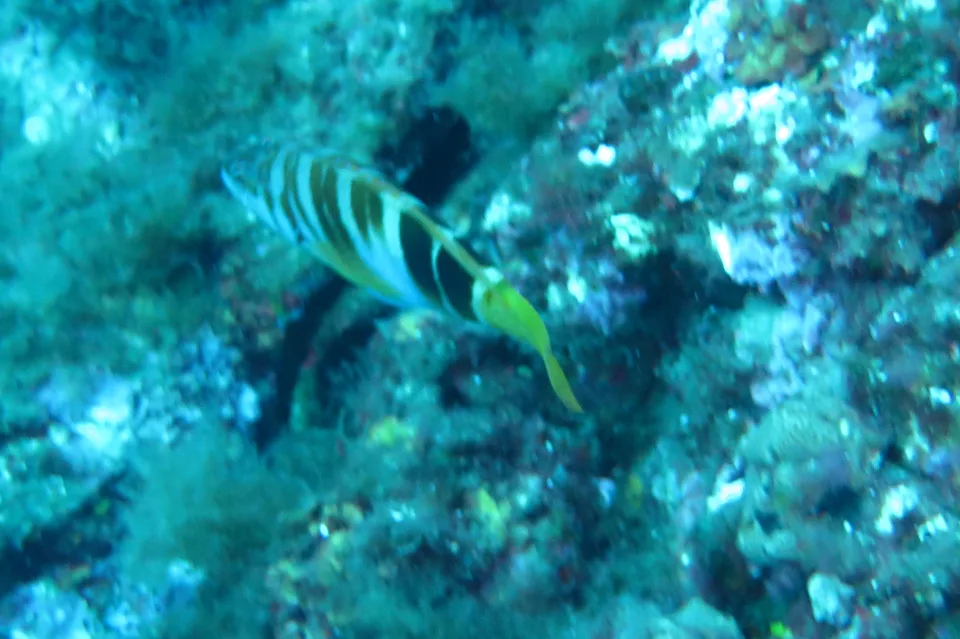
Coastal demersal fish of rocky reefs, boulder fields, reef edges, seagrass beds and algal-covered bottoms.
Distribution
Northeastern Atlantic and the Mediterranean Sea, including the Black Sea; recorded from Portugal and the western African coast southward to Senegal, as well as around several nearby Atlantic islands.
Conservation status
Least Concern
Edibility
Edible and locally used as food fish. Flesh is generally regarded as good, but it is a small fish and should be eaten only when properly identified, fresh and handled safely.
Culinary quality / 5
3
Danger level
Harmless
Usual observation depth
5–30 m
Lifespan (years)
0
Behaviour
Usually solitary or found in small loose groups. A territorial, bottom-associated ambush predator that shelters among rocks and vegetation; mainly active by day and around dusk.
Observation zones
Rocky reef, reef edge, boulders, seagrass, algae-covered rock and adjacent sand.
Diet
Carnivorous; feeds mainly on small fishes, crustaceans, cephalopods and other benthic invertebrates.
Reproduction
Oviparous
Identification marks
Robust small grouper with a reddish-brown to olive body, several dark vertical bars, and conspicuous iridescent blue lines and spots on the head. A dark violet-blue patch is typically visible on the belly behind the pectoral fin.
Similar species
Often confused with the comber, Serranus cabrilla. S. cabrilla usually has a more uniform barred pattern and lacks the distinctive bright blue head lines and dark violet-blue belly patch of the painted comber. The brown comber, Serranus hepatus, is generally more uniformly brown and also lacks the characteristic blue facial markings.
Approach rules
Approach slowly and remain neutral in the water column; do not block its route to shelter. Keep a respectful distance of about 1–2 m, avoid repeated close flash photography, and never feed or touch the fish.
Protection
IUCN assessed as Least Concern. No CITES listing is known. Protect reef habitat and avoid unnecessary collection; local fishing and protected-area rules may apply.