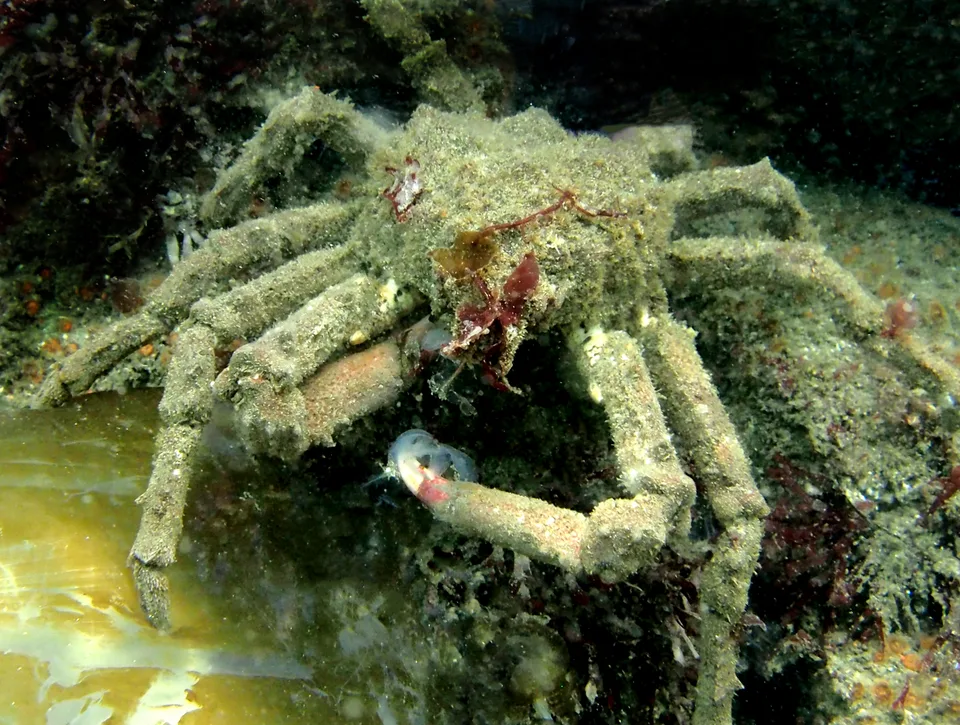
Found along the Pacific coast of North America from Alaska to Baja California.
Conservation status
Least Concern
Edibility
Edible and regarded as good-quality crab meat. Consume only specimens obtained through responsible, lawful harvest; local health advisories may apply.
Culinary quality / 5
4
Danger level
Caution
Usual observation depth
5–60 m
Behaviour
Generally solitary and mainly active at night. It moves slowly along the seafloor, shelters among kelp or rocks, and may gather seasonally during reproduction or migrations.
Observation zones
Rocky reef, kelp forest, sand, mud, bay and shallow coastal bottoms.
Diet
Omnivorous, scavenging and predatory, feeding on algae, kelp, detritus, small molluscs, worms, echinoderms and other benthic invertebrates.
Reproduction
Oviparous
Identification marks
Very large spider crab with an elongated, triangular carapace, a pointed rostrum projecting forward, long, robust walking legs and prominent claws. Its colour is often reddish brown to brown, sometimes masked by algae or other attached organisms.
Similar species
It may be confused with other spider crabs of the genus Loxorhynchus, particularly Loxorhynchus crispatus. L. grandis is distinguished mainly by its distinctly larger adult size and more robust appearance; precise identification may require examination of the carapace spines and rostrum shape.
Approach rules
Observe calmly without touching, handling, lifting, or feeding the animal. Keep a respectful distance, do not block its path, and use flash sparingly; its pincers can pinch if it is disturbed.
Protection
No CITES listing is known, and the species has not undergone a global assessment on the IUCN Red List. Comply with applicable local conservation measures and adopt responsible harvesting practices.