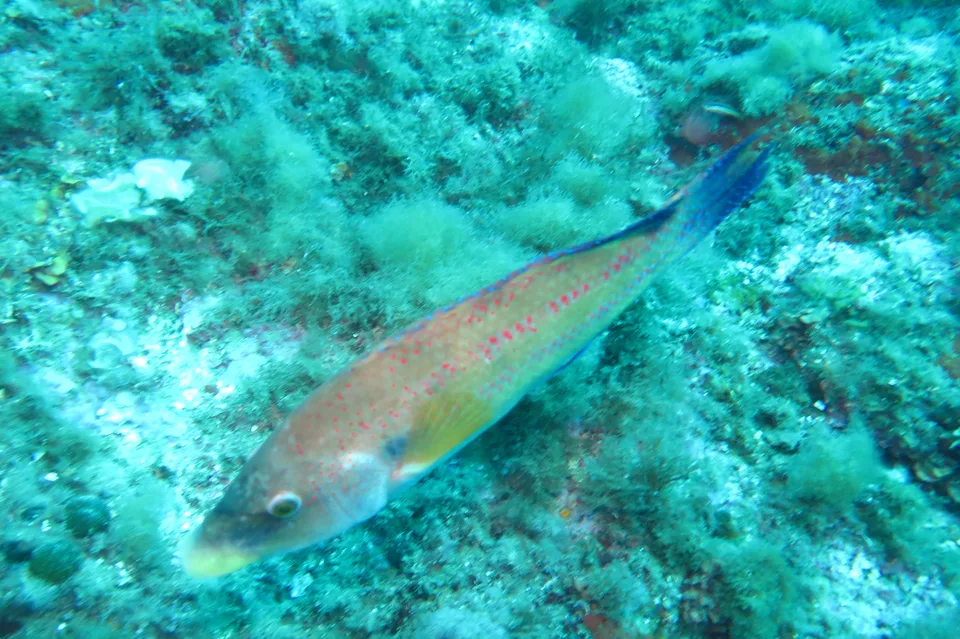
Shallow coastal rocky reefs, seagrass beds and algae-covered substrates; juveniles also occur in tide pools and sheltered shallows.
Distribution
Mediterranean Sea and adjacent northeastern Atlantic, from Portugal and Morocco south to Senegal, including Madeira, the Azores and Canary Islands.
Conservation status
Least Concern
Edibility
Edible but generally of limited culinary interest because of its small size and bony body. Consume only when legally and sustainably obtained; it is not known as toxic.
Culinary quality / 5
2
Danger level
Harmless
Usual observation depth
1–30 m
Lifespan (years)
0
Behaviour
A diurnal, active and mobile wrasse. Usually seen singly or in small loose groups while foraging; juveniles may form small groups. It buries or shelters in the substrate or crevices at night. A protogynous hermaphrodite, with some females changing sex to males.
Mainly small benthic invertebrates, including crustaceans, molluscs, worms and other small bottom-dwelling animals.
Reproduction
Oviparous
Identification marks
Elongate wrasse with a pointed snout and continuous dorsal fin. Adults are brightly patterned, typically green to blue-green with orange to reddish wavy lines or bars and a dark spot near the rear of the dorsal fin. Colour pattern varies strongly with age, sex and social phase; juveniles are less vividly coloured.
Similar species
May be confused with other Mediterranean wrasses, especially the peacock wrasse Symphodus tinca and the rainbow wrasse Coris julis. Thalassoma pavo is usually more vividly green-blue with orange-red wavy markings and a characteristic dark dorsal-fin spot; Coris julis is more slender and commonly shows a strong longitudinal colour division.
Approach rules
Approach slowly and remain low and calm; do not corner the fish against rocks or disturb its feeding area. Keep a respectful distance of about 1–2 m where possible. Avoid repeated close flash photography, never touch or chase it, and do not feed it.
Protection
Globally assessed as Least Concern on the IUCN Red List. No CITES listing is known. Protect coastal reef, seagrass and shallow-water habitats, and avoid collecting or disturbing individuals.