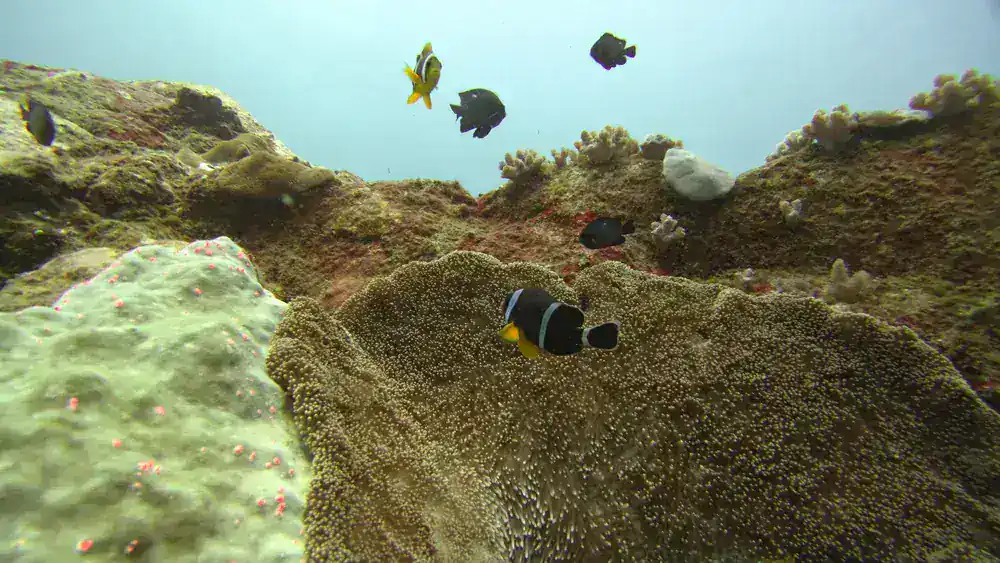
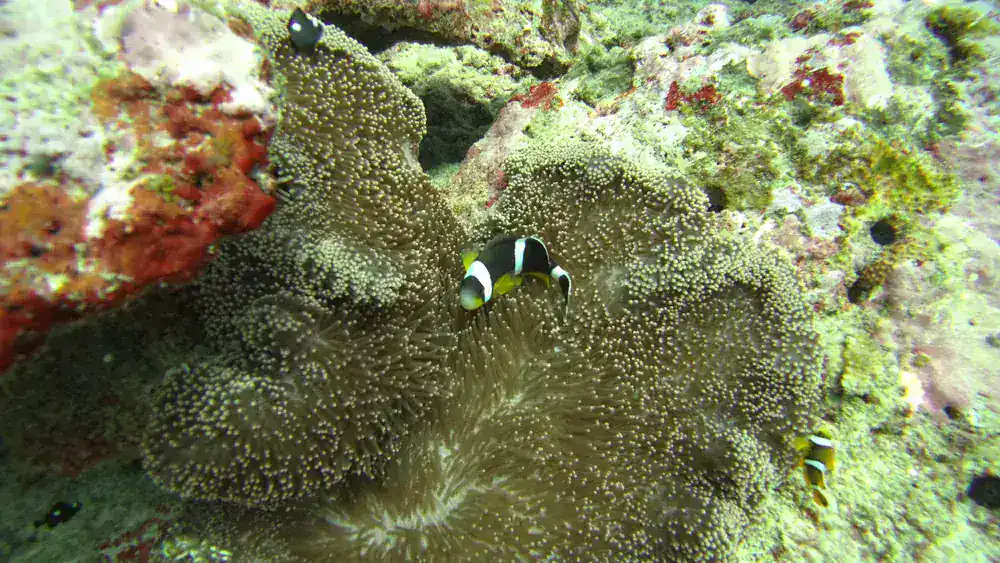
Found in lagoons and outer reefs, associated with sea anemones.
Distribution
Western Indian Ocean: Mauritius.
Conservation status
Least Concern
Edibility
Edibility and culinary quality are poorly documented. This small reef fish is chiefly an ornamental species and is not generally regarded as a food fish.
Danger level
Harmless
Usual observation depth
3–20 m
Behaviour
Lives in socially structured groups associated with a host anemone, generally dominated by a breeding female and a smaller male. Territorial around its anemone and active during the day. Eggs are deposited on a hard substrate near the anemone and guarded by the male.
Observation zones
Coral reef, rocky reef, reef slope, lagoon, and areas containing host anemones.
Diet
Omnivore; feeds mainly on zooplankton, small benthic invertebrates, algae, and food particles collected near its host anemone.
Reproduction
Oviparous
Identification marks
Relatively large, deep-bodied clownfish. Adults are mostly dark brown to black, with orange to golden yellow on the snout, lower head, chest and belly. It has two pale vertical bands: a broad band behind the eye and a narrower band on the body.
Similar species
Can be confused with other two-banded clownfish. The Red Sea two-banded clownfish, Amphiprion bicinctus, is generally more orange-yellow and occurs outside the Mascarene region. The dark body, golden-orange underside, and distribution in the Mascarenes allow A. chrysogaster to be identified.
Approach rules
Observe calmly from at least 1 to 2 m away. Do not touch, handle, feed, or block the host anemone. Avoid excessive use of flash and move back if the fish makes repeated defensive charges.
Protection
IUCN: Least Concern. The species is not listed under CITES. Protect reefs and host anemones, and avoid unnecessary collection for the aquarium trade.