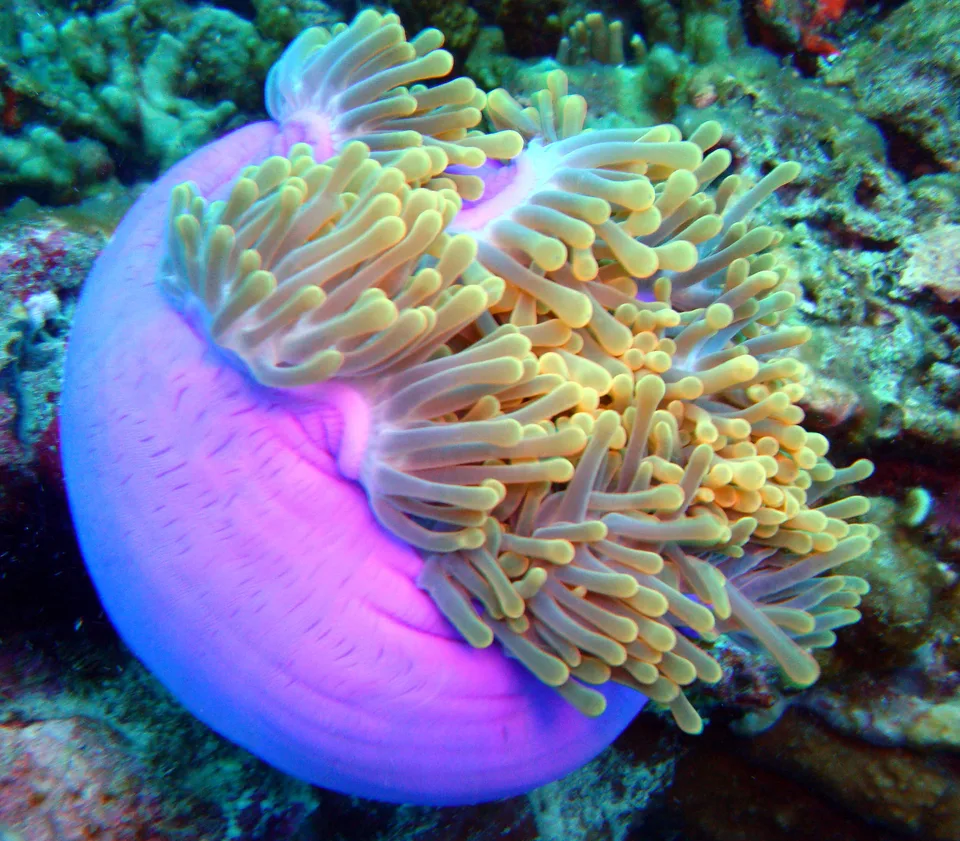
Typically found in shallow waters, often attached to rocks or coral reefs.
Distribution
Found in the Atlantic and Pacific Oceans, particularly in tropical and subtropical regions.
Conservation status
Least Concern
Edibility
Not recommended for consumption. It is not a customary food species and its stinging cells may cause irritation; do not collect or handle it.
Danger level
Caution
Usual observation depth
1–30 m
Behaviour
A sessile, generally solitary sea anemone that remains expanded in daylight when conditions are suitable and can contract when disturbed. It hosts symbiotic algae and commonly shelters clownfishes; it may also reproduce asexually, creating nearby clones.
Observation zones
Reef: exposed reef crests, upper reef slopes, pinnacles and rocky reef areas. Usually absent from sand, mangroves, wreck interiors and caves.
Diet
Receives much of its energy from symbiotic zooxanthellae and also captures zooplankton, small crustaceans, fish larvae and other small drifting prey with its tentacles.
Reproduction
Oviparous
Identification marks
Large oral disc, often up to about 1 m across, with numerous long, smooth, pointed tentacles that are usually brown, greenish, yellowish or purple-tipped. The column is commonly brown, reddish or purple and is firmly anchored in a crevice or on exposed rock. Often occupied by clownfish.
Similar species
May be confused with Heteractis crispa, which usually has slimmer, more tapering tentacles and often distinct purple tips, or Heteractis aurora, which has characteristic bead-like tentacles. Carpet anemones (Stichodactyla spp.) have shorter, denser tentacles and a more carpet-like disc.
Approach rules
Observe without touching, holding or moving the anemone or its host fish. Maintain careful buoyancy and avoid fin wash; do not feed it. Keep a respectful distance, especially from the tentacles. Avoid direct or repeated flash photography, and follow site-specific rules.
Protection
Globally assessed as Least Concern on the IUCN Red List. Wild collection for the aquarium trade can affect local populations; avoid disturbance and use responsibly sourced captive-bred specimens where relevant.