Pelagic waters, often found in offshore environments.
Distribution
Found in temperate and tropical oceans worldwide.
Conservation status
Least Concern
Edibility
Edible as food, but this species is Critically Endangered; it should not be consumed and conservation should be prioritized. Its meat and fins have historically been exploited.
Culinary quality / 5
3
Danger level
Dangerous
Usual observation depth
?–200 m
Lifespan (years)
22
Behaviour
Usually solitary or seen in loose small groups. Active both by day and night, it slowly patrols open water and can become very persistent around food, injured fish, or human activity. It is a curious and potentially dangerous shark.
Observation zones
Blue water, areas around oceanic islands, drop-offs, and offshore waters; rarely on shallow reefs.
Diet
An opportunistic predator feeding mainly on pelagic fishes, including tunas and mackerels, as well as squid, rays, seabirds, carrion, and occasionally floating refuse.
Reproduction
Viviparous
Identification marks
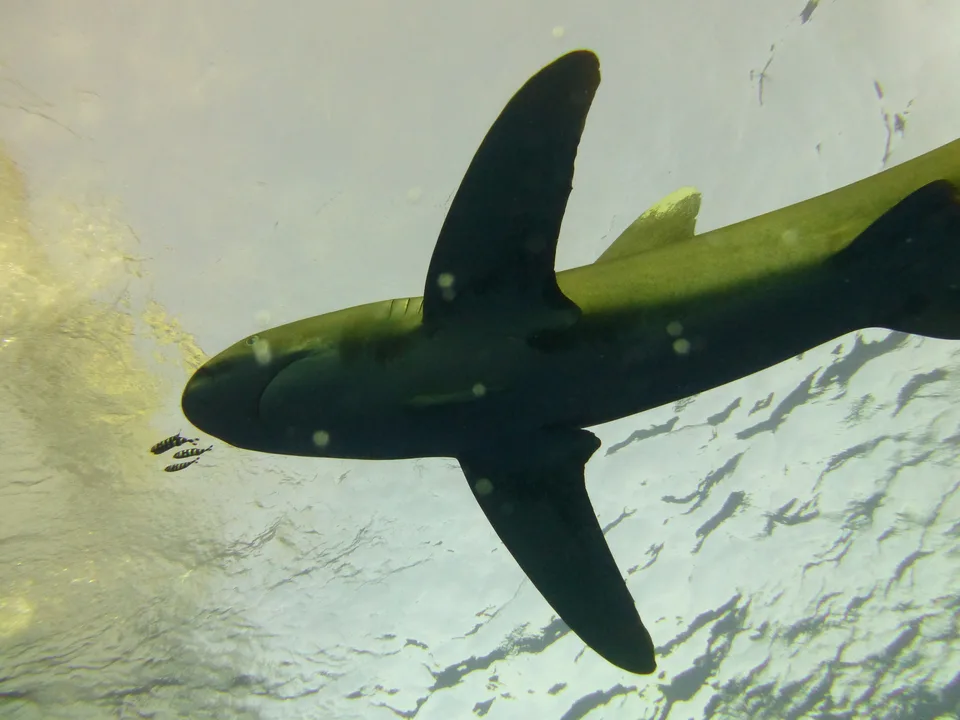
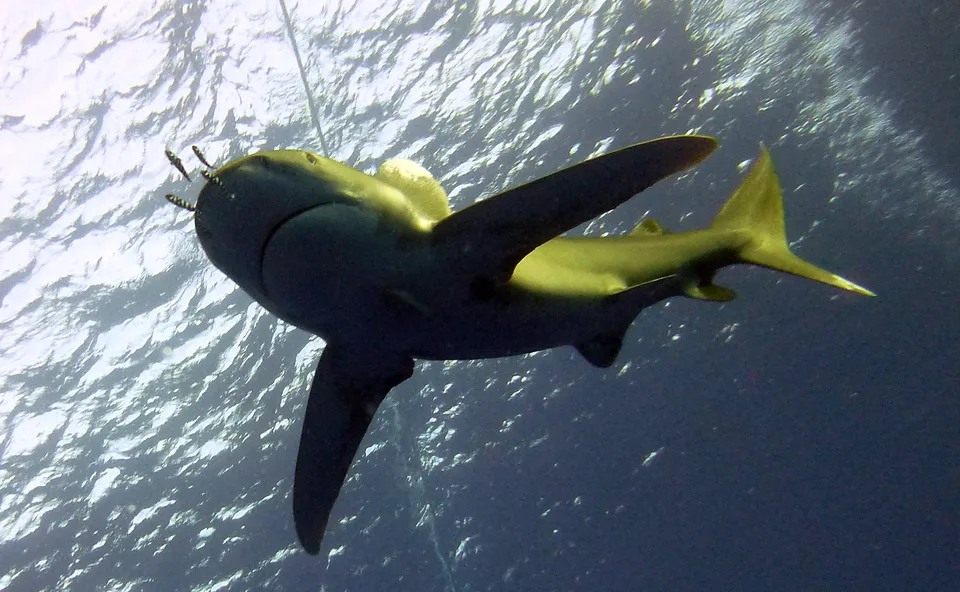
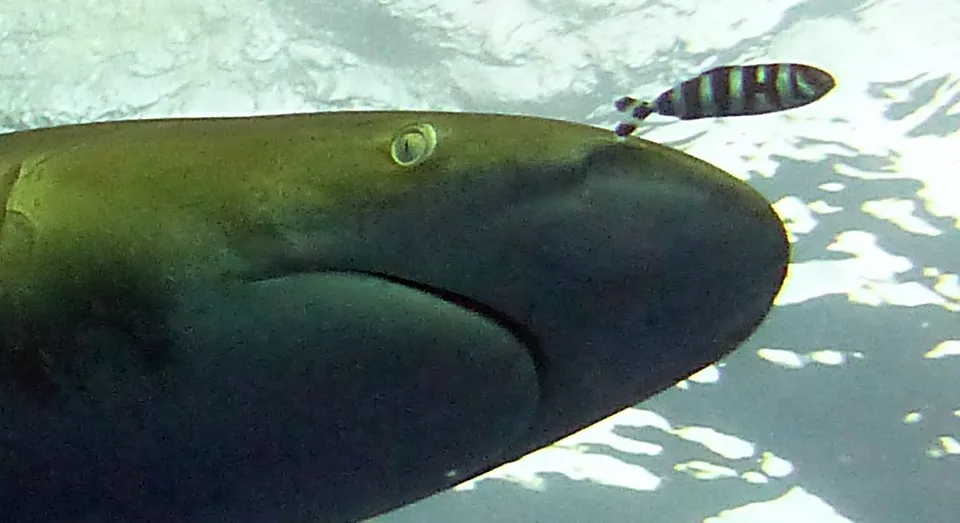
A large, robust grey-brown shark with a short, rounded snout. Its exceptionally long, broad, rounded pectoral fins and first dorsal fin have white or mottled-white tips; other fins may also show pale tips.
Similar species
It can be confused with the silky shark (Carcharhinus falciformis), which has shorter, narrower pectoral fins and a more streamlined profile. The oceanic whitetip is distinguished by its very long, broadly rounded pectoral fins with conspicuous white tips.
Approach rules
Observe only with an experienced operator. Stay grouped, alert, and facing the animal; keep at least 5 m distance and maintain an exit route. Do not touch, chase, or block its path, and do not enter the water near fishing, bait, or injured fish. Never feed it; avoid close-range or repeated flash photography.
Protection
Critically Endangered on the IUCN Red List. Listed in CITES Appendix II, meaning international trade is regulated through a permit system. Conservation and avoidance of accidental capture are priorities.