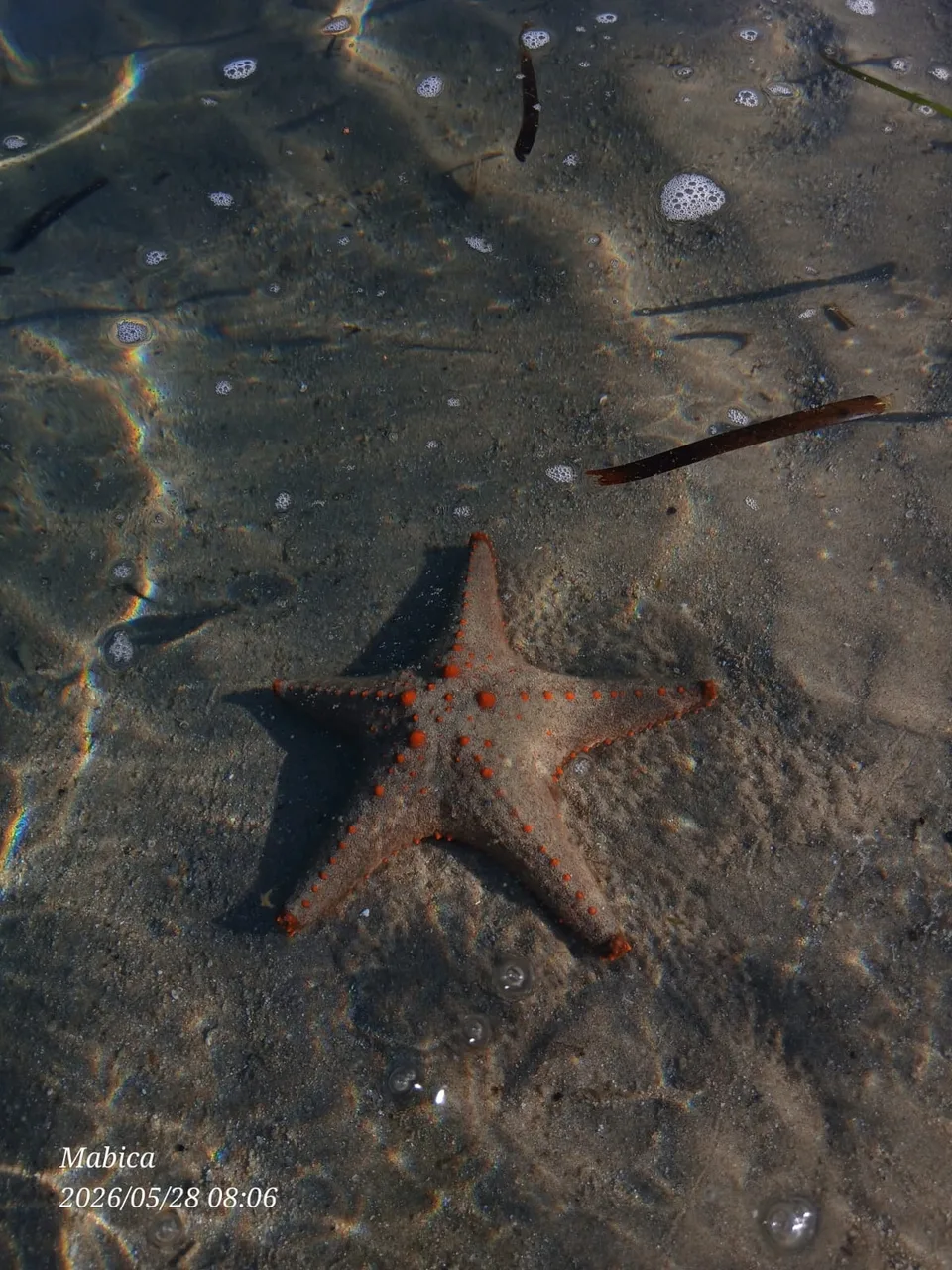
Found in shallow waters, typically on coral reefs and rocky substrates.
Distribution
Native to the Indo-Pacific region, including the Red Sea and the western Pacific.
Conservation status
Least Concern
Edibility
Not commonly consumed and its culinary use is poorly documented. It is not regarded as a usual seafood species; avoid collecting wild sea stars for food.
Danger level
Harmless
Usual observation depth
1–15 m
Behaviour
Slow-moving benthic sea star, generally observed alone but sometimes in loose groups when conditions are favorable. It is generally active during the day and feeds by grazing or scavenging materials at the surface.
Observation zones
Shallow reefs, reef flats, lagoons, seagrass beds, sandy areas and coral rubble bottoms.
Diet
Feeds mainly on detritus, organic films, algae, microorganisms and small sessile invertebrates or their remains on hard and sandy substrates.
Reproduction
Oviparous
Identification marks
Large robust five-armed starfish with a broad central disc. The upper surface is variable, cream, grey, brown or reddish, and bears clearly visible rounded tubercles, red to orange, arranged on the arms and disc.
Similar species
It can be confused with the horned sea star, Protoreaster nodosus. P. nodosus generally has fewer but larger, more prominent and darker knobs; P. linckii typically bears more numerous rounded red to orange tubercles and has a more marbled appearance.
Approach rules
Observe it without touching, lifting, turning over, or moving it. Maintain neutral buoyancy and avoid any contact with the bottom; do not feed it. Do not use flash, or use only minimal flash if photography is necessary.
Protection
Assessed globally as Least Concern on the IUCN Red List. It is not listed under CITES; nevertheless, avoid any unnecessary collection, as local populations may be affected by harvesting and the aquarium trade.