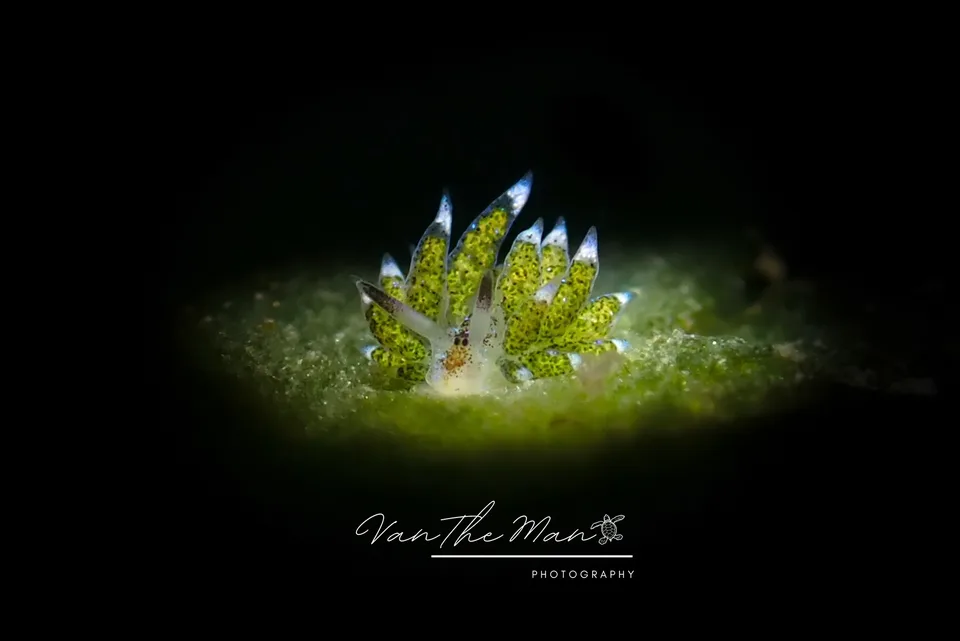
Found in the Indo-Pacific region, particularly around Japan and the Philippines
Conservation status
Data Deficient
Edibility
Not used as food. This tiny sea slug has no documented culinary value and should not be collected or consumed.
Danger level
Harmless
Usual observation depth
?–10 m
Behaviour
Generally solitary and active during the day. It crawls slowly on host algae and can retain functional chloroplasts from its food (kleptoplasty), which gives it a green appearance.
Specialized herbivore feeding mainly on siphonous green algae, particularly species of Avrainvillea. It incorporates chloroplasts from the algae into its tissues.
Reproduction
Oviparous
Identification marks
Very small sacoglossan, generally about 5 mm long, with a white body, two dark eyes, and numerous leaf-shaped green cerata. The cerata often have pale pink to reddish tips, giving it the characteristic “leaf sheep” appearance.
Similar species
Other Costasiella species, notably C. usagi and C. ocellifera, may resemble it. The color and pattern of the cerata tips vary; reliable identification may require clear close-up photographs, locality information, and examination by a specialist.
Approach rules
Observe without touching, moving, or collecting the animal or its host algae. Maintain excellent buoyancy to avoid any contact with the substrate. Use brief, low-power lighting and flash; never feed the wildlife.
Protection
Currently not assessed on the IUCN Red List and not listed under CITES. General advice: avoid collection and protect shallow algal and reef habitats.