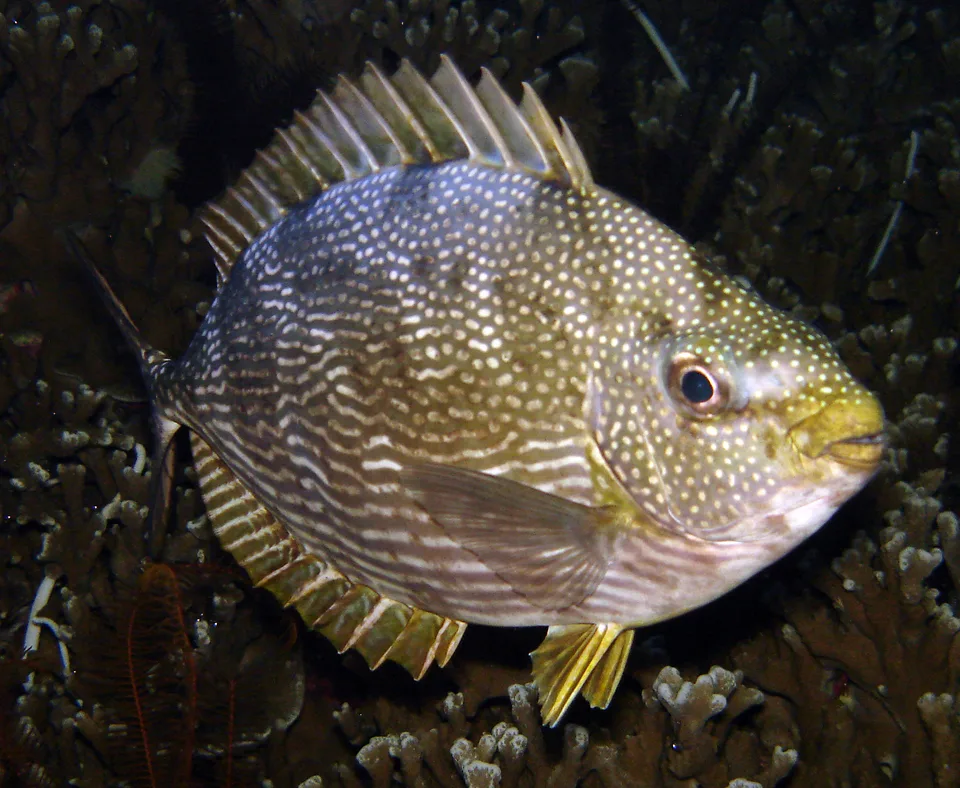
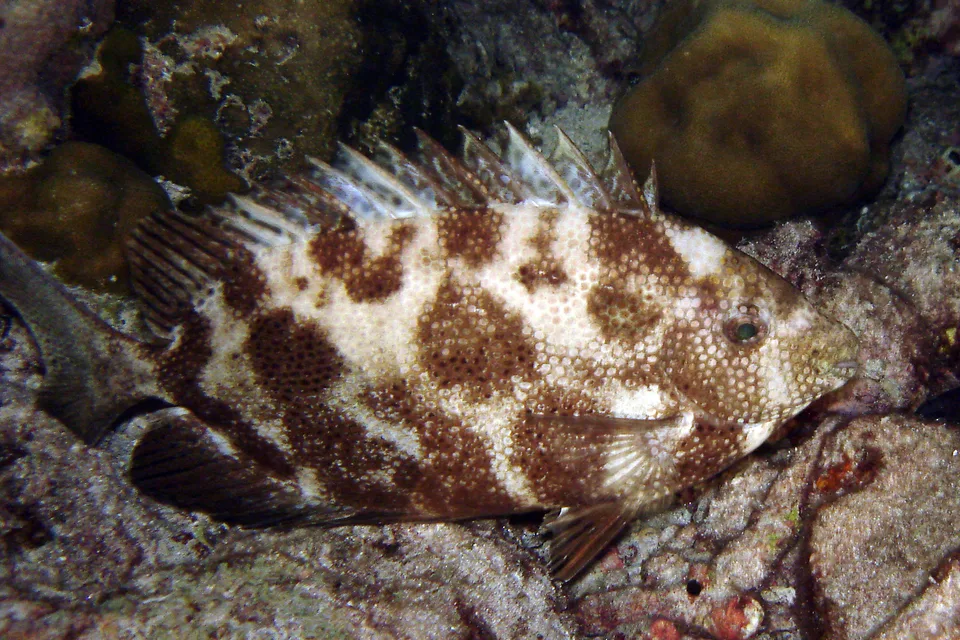
Edible and locally used as food. Handle carefully because the dorsal, anal and pelvic fin spines are venomous; cook thoroughly and avoid fish from areas with known ciguatera risk.
Culinary quality / 5
3
Danger level
Caution
Usual observation depth
1–20 m
Behaviour
Observed alone, in pairs or small groups; juveniles may form schools. Diurnal and primarily active while grazing during the day, often taking refuge in reef structure or vegetation.
Primarily herbivorous, feeding on benthic algae and other plant matter, including seagrasses when available. It may also accidentally ingest small sessile invertebrates.
Reproduction
Oviparous
Identification marks
Rabbitfish with a deep, laterally compressed body, a small pointed snout, and a long continuous dorsal fin. Adults are gray-green to brownish, with fine wavy horizontal bluish lines on the head and flanks; the venomous spines are clearly visible.
Similar species
It can be confused with other rabbitfish of the genus Siganus. Siganus canaliculatus has distinct pale spots rather than the characteristic wavy blue lines, while Siganus guttatus has orange spots. Examination of the flank pattern is useful.
Approach rules
Approach slowly and calmly without blocking its escape route. Keep a respectful distance of at least 1 to 2 m, do not touch or handle it due to its venomous spines, avoid repeated flashes and never feed it.
Protection
Classified as “Least Concern” by the IUCN. It is not listed in the CITES appendices. Respect the rules of marine protected areas and avoid collecting animals where restrictions apply.