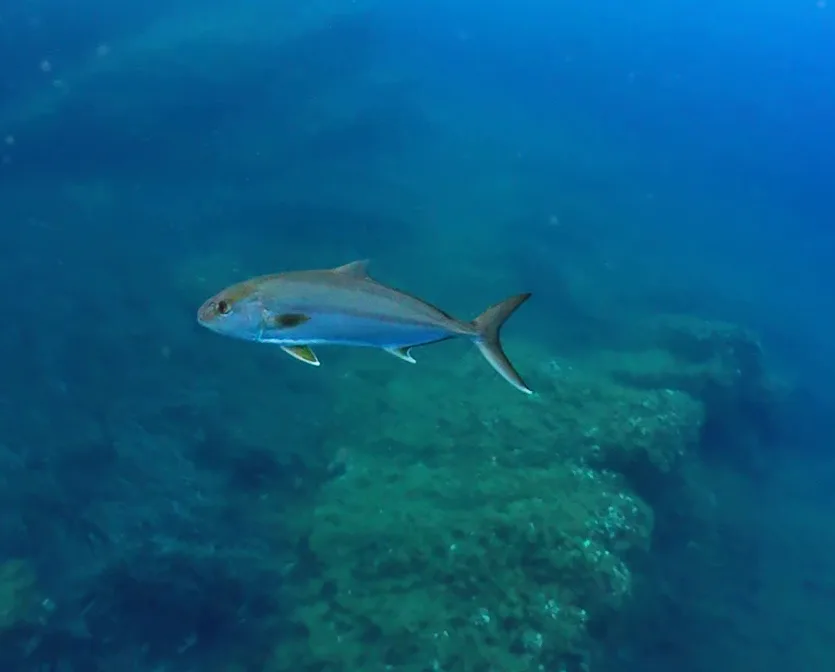
Coastal and offshore waters, often around reefs and wrecks.
Distribution
Found in the Atlantic Ocean, from New England to Brazil, and in the Mediterranean Sea.
Conservation status
Least Concern
Edibility
Edible and generally regarded as a good food fish. It may be eaten fresh or cooked; as a large predatory fish, consumption should be moderate where mercury advisories apply.
Culinary quality / 5
4
Danger level
Harmless
Usual observation depth
10–80 m
Lifespan (years)
17
Behaviour
Generally solitary or observed in small groups, but may form larger schools around reefs, seamounts, or floating objects. Active diurnal predator, often patrolling open water near structures.
Observation zones
Open water, offshore reef slopes, drop-offs, seamounts, pinnacles, wrecks and areas around floating objects.
Diet
Feeds mainly on fish, squid and other cephalopods, as well as crustaceans.
Reproduction
Oviparous
Identification marks
Amberjack with a deep, laterally compressed body, a steep forehead, a dark band crossing the eye, and elongated, sickle-shaped anterior lobes of the dorsal and anal fins in adults. Juveniles have clearly visible dark vertical bars.
Similar species
May be confused with the greater amberjack (Seriola dumerili) and the yellowtail amberjack or yellowtail kingfish (Seriola lalandi). Seriola rivoliana generally has a deeper body, a steeper head profile, a more distinct dark eye stripe and longer sickle-shaped fin lobes.
Approach rules
Approach calmly and predictably. Keep a respectful distance, avoid blocking its path or pursuing it, do not touch or feed it, and avoid flash at close range.
Protection
Assessed globally as « Least Concern » on the IUCN Red List. No CITES listing is known. Favor responsible consumption recommendations, as stocks and their management vary by region.