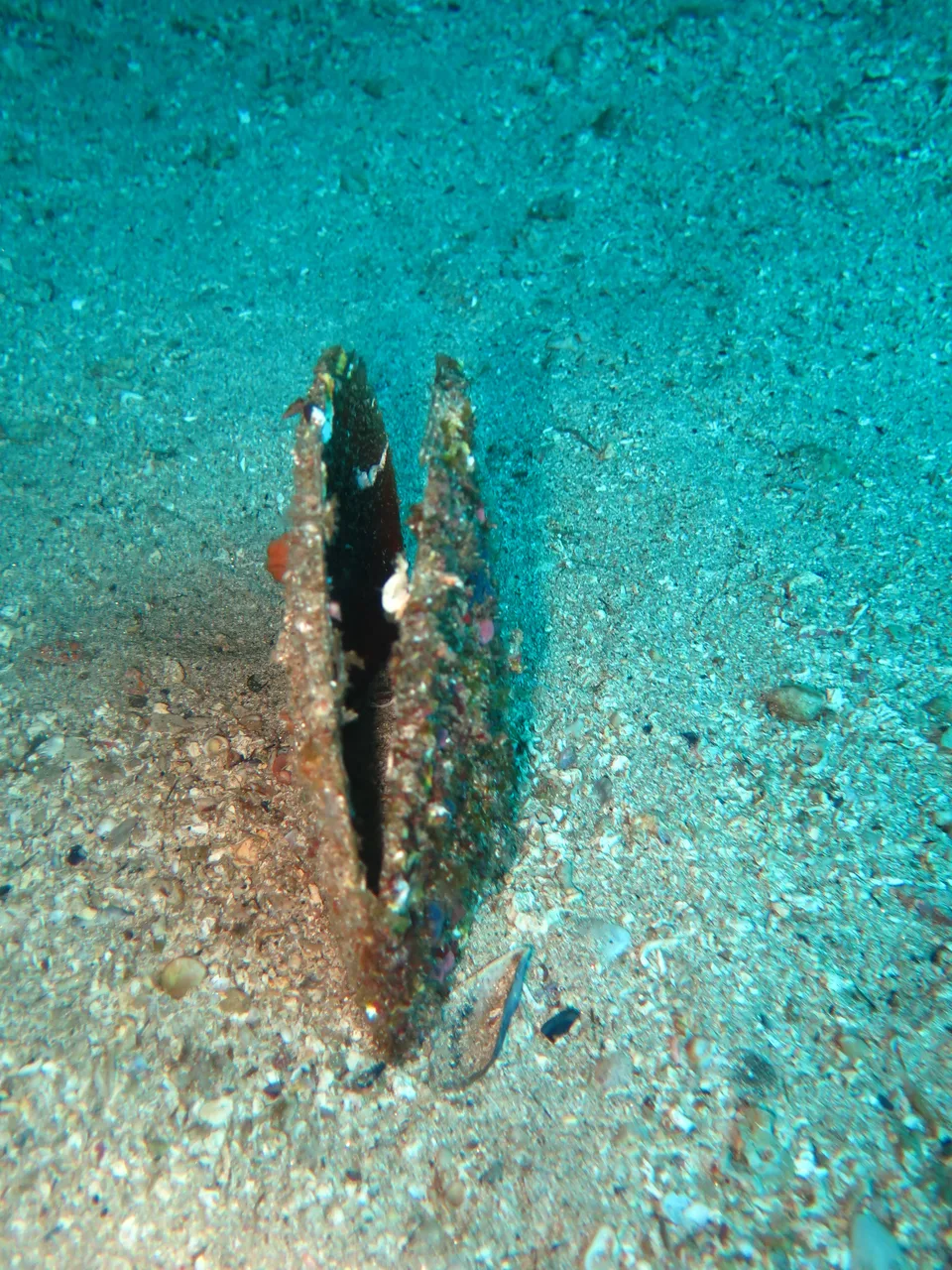
Found in shallow coastal waters, often in sandy or muddy substrates.
Distribution
Widespread in tropical and subtropical regions of the world.
Conservation status
Least Concern
Edibility
Edible historically, but this Critically Endangered species must not be collected or consumed; do not infer local legality.
Culinary quality / 5
3
Danger level
Harmless
Usual observation depth
1–30 m
Lifespan (years)
50
Behaviour
A sedentary, solitary bivalve. It remains partly buried and filters seawater continuously; adults are simultaneous hermaphrodites that broadcast gametes into the water.
Observation zones
Seagrass meadows, sandy bottoms, muddy bottoms and sheltered coastal lagoons.
Diet
A suspension feeder that filters phytoplankton, microalgae, organic particles and microorganisms from seawater.
Reproduction
Oviparous
Identification marks
Very large, narrow wedge-shaped shell, often projecting vertically from the seabed; brown to reddish-brown exterior with scale-like projections, and a pearly inner surface. It may reach about 120 cm.
Similar species
May be confused with the rough pen shell, Pinna rudis. P. nobilis is generally much larger and has a more elongated shell; P. rudis is usually smaller, broader and more strongly sculptured.
Approach rules
Observe from a respectful distance. Do not touch, handle, move or insert objects into the shell; avoid fin-kicks that resuspend sediment, do not feed it, and avoid close direct flash photography.
Protection
Critically Endangered globally. Do not collect, damage or disturb individuals; conservation measures and restrictions may apply and should be checked locally.