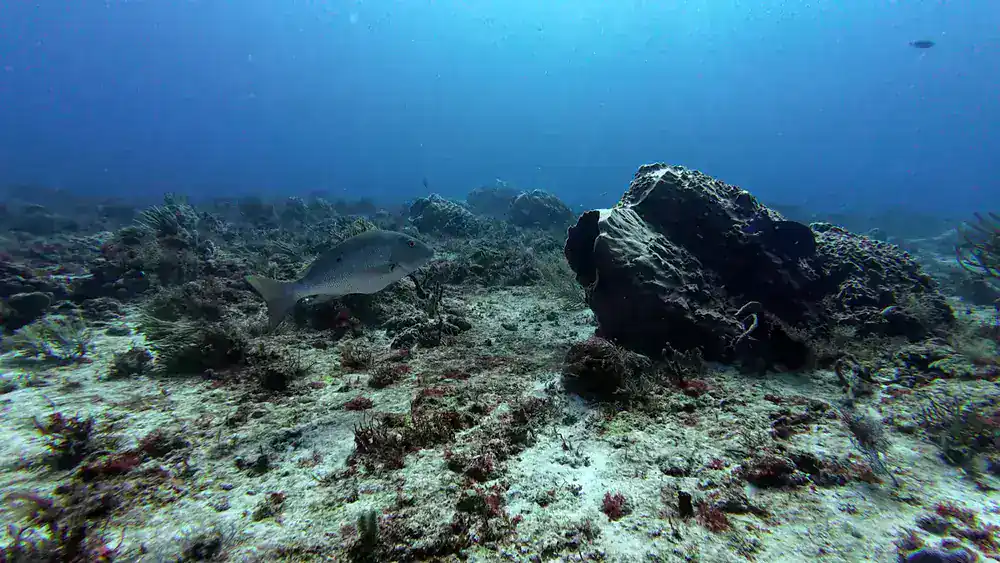
Western Atlantic, including the Gulf of Mexico and Caribbean Sea
Conservation status
Least Concern
Edibility
A well-regarded food fish. Larger reef-associated individuals in tropical areas can pose a ciguatera risk; consume only fish from reliable sources and follow applicable health advisories.
Culinary quality / 5
4
Danger level
Harmless
Usual observation depth
1–30 m
Lifespan (years)
25
Behaviour
Juveniles are often solitary or in small groups in sheltered nursery habitats. Adults are generally solitary or form small, loose aggregations near shelter; they are primarily nocturnal predators, often resting under cover during the day.
Opportunistic carnivore feeding mainly on fish, crustaceans such as crabs and shrimp, and cephalopods; juveniles also consume small benthic invertebrates.
Reproduction
Oviparous
Identification marks
Snapper with a moderately deep body, gray to olive gray, with a reddish or bronze tint on the head. It generally has faint bars or dark lines on the flanks, a dark band extending across the eye toward the rear of the operculum, and a fairly large mouth equipped with canine-like teeth. The fins are generally dark rather than bright yellow.
Similar species
Often confused with other Lutjanus of the western Atlantic. The dog snapper (Lutjanus apodus) has a clearly visible yellow spot below the front of the dorsal fin and generally brighter yellow fins. The mahogany snapper (Lutjanus mahogoni) has a distinct dark spot below the rear of the dorsal fin and more yellowish coloration. The cubera snapper (Lutjanus cyanopterus) grows much larger and has a more massive head and much more developed canine teeth.
Approach rules
Approach slowly and calmly without blocking its path to shelter. Keep a respectful distance of at least 2 m, avoid cornering or touching it, and do not feed it. Use the flash sparingly and never repeatedly at close range.
Protection
Globally assessed as “Least Concern” on the IUCN Red List. It is not listed in the CITES appendices. Fisheries management and habitat protection measures may vary by area; consult the local measures in force when necessary.