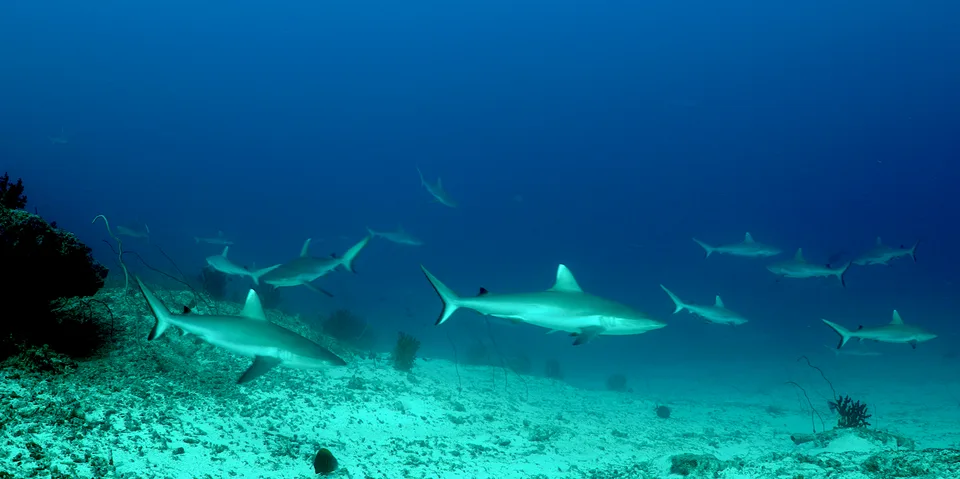
Found in tropical and subtropical waters around the world.
Conservation status
Least Concern
Edibility
Edible, but consumption is not recommended because the species is Vulnerable, can accumulate mercury, and shark products may come from unsustainable fisheries.
Culinary quality / 5
3
Danger level
Caution
Usual observation depth
1–280 m
Lifespan (years)
25
Behaviour
Active both day and night. Often solitary, but may form aggregations or loose groups in passes and around island reefs. Territorial or site-faithful in some areas, and may adopt an intimidation posture when threatened: arched back, lowered pectoral fins and accentuated swimming.
Observation zones
Outer reef slopes, passes, channels, drop-offs and open water near reefs; occasionally in lagoons.
Diet
Primarily bony fish, particularly reef fish, but also cephalopods and crustaceans. It may occasionally catch rays and small sharks.
Reproduction
Viviparous
Identification marks
Stocky grey shark with a broad, rounded snout; grey back and pale belly; clearly visible black posterior margin or tip on the caudal fin, dark tips on the pectoral fins and a broad black margin on the first dorsal fin. The first dorsal fin is relatively large and the second is small.
Similar species
Often confused with the blacktip reef shark (Carcharhinus melanopterus), which generally has more distinct black tips, a smaller first dorsal fin, and more often frequents very shallow lagoons. It may also resemble the silvertip shark (Carcharhinus albimarginatus), with distinctly white fin margins, and the dusky shark (Carcharhinus obscurus), which lacks the characteristic black margin of the caudal fin.
Approach rules
Observe calmly from a respectful distance, ideally at least 3 m away. Do not block its access to open water, pursue it, touch it, corner it, or feed it. Avoid sudden movements and flash photography. Calmly leave the area if it adopts a threatening posture or becomes unusually insistent.
Protection
Globally assessed as Vulnerable on the IUCN Red List. International trade is regulated by CITES Appendix II under the listing of grey sharks (Carcharhinidae).