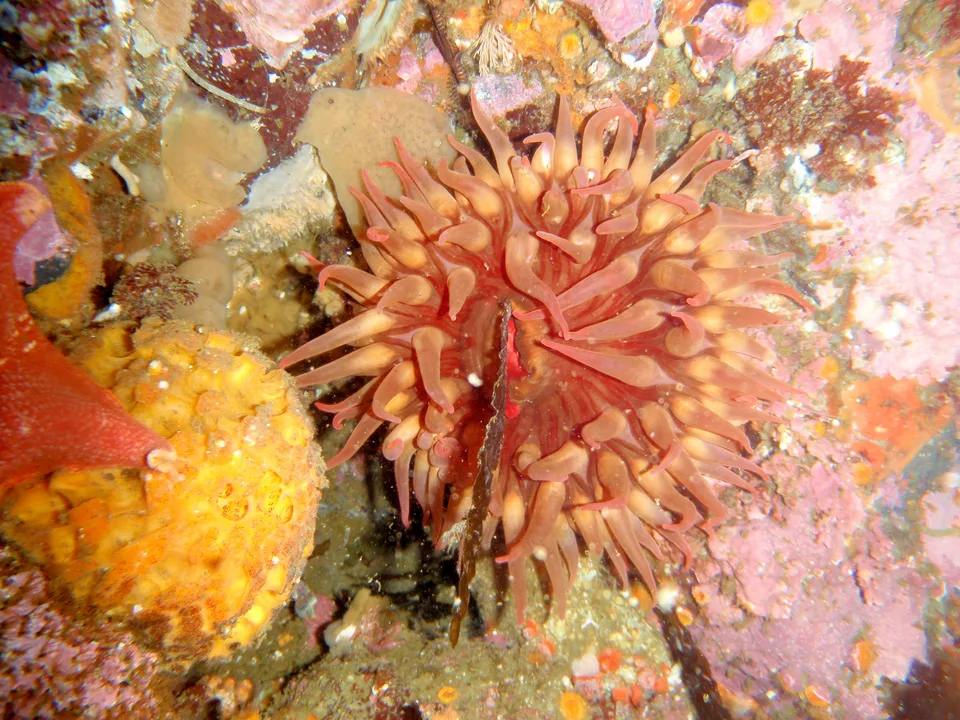
Intertidal zones, often found on rocky substrates.
Distribution
Pacific coast of North America, from Alaska to California.
Conservation status
Least Concern
Edibility
Not generally used as food; culinary quality is undocumented. Do not collect or consume without reliable local health and harvest guidance.
Danger level
Caution
Usual observation depth
?–5 m
Behaviour
Often occurs in dense clonal aggregations formed by asexual pedal laceration, although solitary individuals also exist. It retracts its tentacles and closes during emergence at low tide. Many individuals host symbiotic algae.
Observation zones
Rocky reef, intertidal pools, shallow rocky shore and shallow subtidal hard bottom.
Diet
Capture of small zooplankton, small crustaceans, larvae and organic particles with its tentacles; symbiotic algae also provide nutrients from photosynthesis.
Reproduction
Oviparous
Identification marks
Large oral disc bearing numerous short tentacles, often green, brown, or gray with pale radial markings. Frequently forms dense patches of genetically identical individuals on rock. The tentacles retract completely when disturbed or exposed.
Similar species
Can be confused with other anemones of the genus Anthopleura, notably the giant green anemone (Anthopleura xanthogrammica). A. xanthogrammica is much larger, generally a more uniform bright green, and does not usually form the same dense clonal mats. Color alone is not reliable.
Approach rules
Observe without touching, lifting, or pressing the anemone. Keep fins and hands away from the substrates of tide pools, do not feed the animal, and do not use flash, or use only minimal flash for close-up photographs. Contact can stress the animal and cause a slight sting.
Protection
No global IUCN assessment is known for this species, which is not listed under CITES. Avoid unnecessary collection and disturbance, particularly in intertidal habitats vulnerable to trampling and degradation.