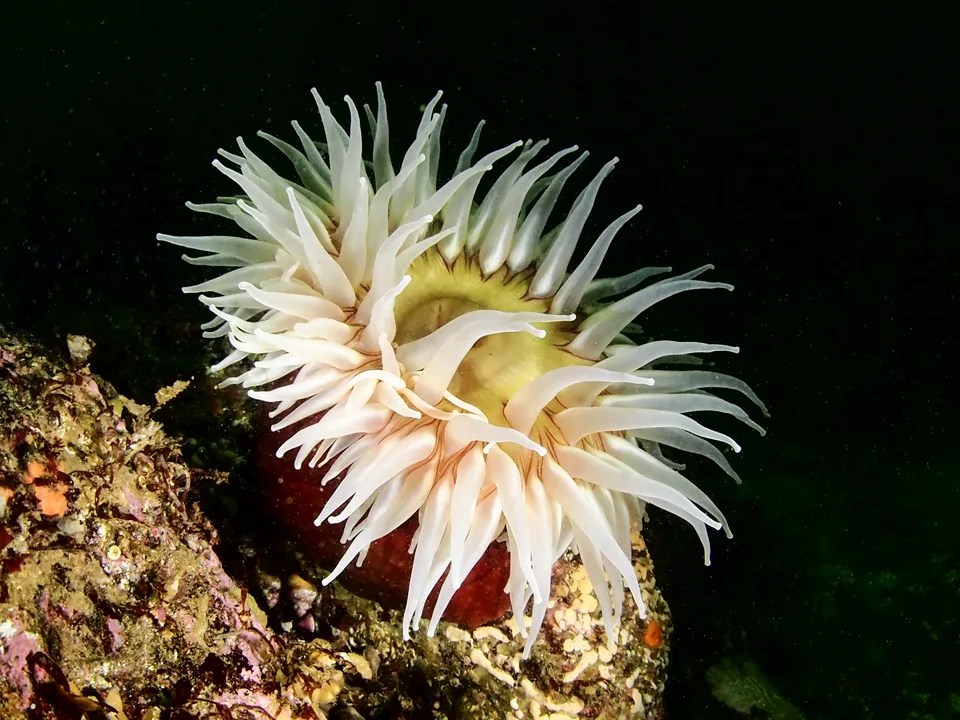
Typically found in rocky substrates and tidal pools.
Distribution
Found along the Pacific coast of North America.
Conservation status
Least Concern
Edibility
Not regarded as a food species; culinary use is undocumented. Do not collect or consume wild sea anemones without reliable species identification and applicable local guidance.
Danger level
Harmless
Usual observation depth
?–30 m
Behaviour
Sessile and solitary, although many individuals may form dense aggregations on suitable structures. It extends its tentacles to filter-feed, contracts when disturbed, and can reproduce both sexually and asexually through fragmentation.
Observation zones
Rocky reefs, hard substrates in kelp forests, dock and pontoon pilings, jetties, artificial structures and shipwrecks; frequently at coastal sites exposed to currents.
Diet
Predator feeding on suspended particles. It captures zooplankton, small crustaceans, larvae, fish eggs, and other small drifting animals using its stinging tentacles.
Reproduction
Oviparous
Identification marks
Very large anemone with a smooth, elongated column, often white, cream, orange, brown or pink. Its broad oral disc bears an exceptionally dense crown of numerous short, slender tentacles, giving it a feathery appearance. Large individuals can exceed 1 m in height when extended.
Similar species
Often confused with other plumose anemones, particularly Metridium senile. Metridium farcimen is generally much larger and more robust, with a very dense crown of tentacles. Contracted individuals and small specimens can be difficult to identify reliably; anatomical or genetic examination may be necessary.
Approach rules
Observe without touching, handling, collecting, or feeding the animal. Maintain neutral buoyancy and avoid any contact between your fins and the substrate. Maintain a respectful distance and limit the use of flash; do not repeatedly illuminate a contracted animal and do not disturb it.
Protection
Not listed under CITES. No global IUCN assessment is currently known for this species; respect site-specific conservation rules and avoid collecting or damaging individuals and their habitat.