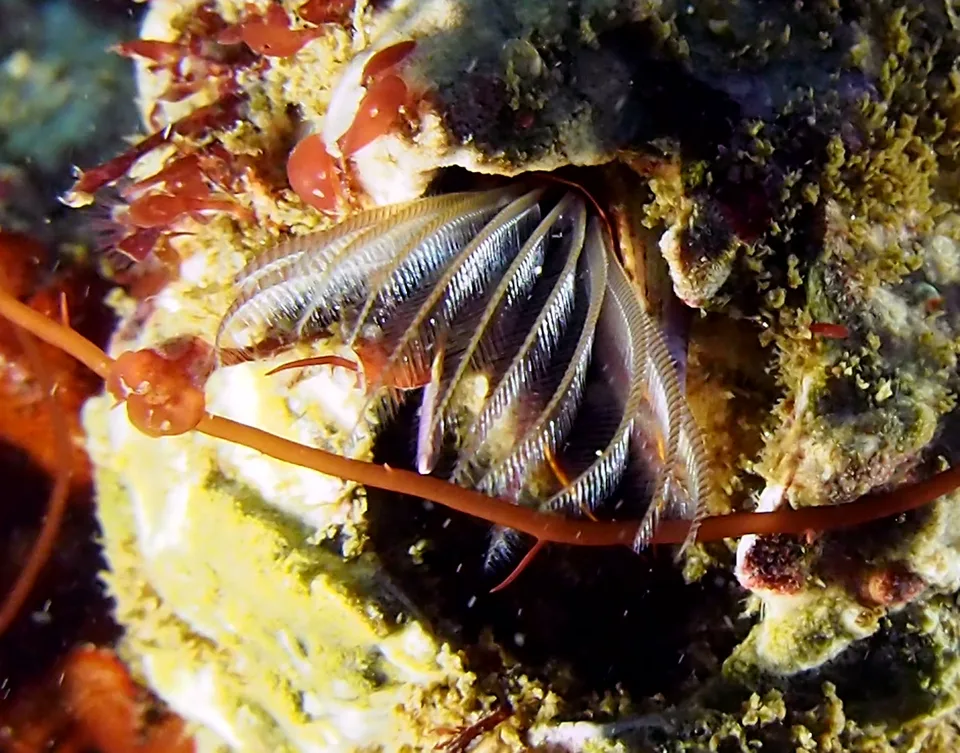
Typically found in shallow waters on coral reefs and rocky substrates.
Distribution
Found in tropical and subtropical waters around the world.
Conservation status
Least Concern
Edibility
Not regarded as food; culinary use is undocumented and collection should be avoided.
Danger level
Harmless
Usual observation depth
10–60 m
Behaviour
Rather sedentary but mobile feather star. It often perches with its arms spread facing the current to feed, and can crawl or swim short distances when disturbed. It is observed alone or in small, loose aggregations.
Observation zones
Rocky reefs, kelp or algal habitats, coralligenous reefs and shaded hard structures; occasionally on colonized shipwrecks.
Diet
Suspension feeder. It captures plankton, tiny crustaceans, organic particles and other suspended matter using the mucous podia on its arms.
Reproduction
Oviparous
Identification marks
Small unstalked crinoid with a compact central disc, ten feathery arms that branch repeatedly, and claw-shaped cirri beneath the body for attachment. Colour variable: often cream, yellowish, brown, reddish, or mottled.
Similar species
May be confused with other feather stars of the genera Antedon and Leptometra. Reliable identification often requires examination of the cirri, arm segmentation, and arrangement of the pinnules; colour alone is not reliable.
Approach rules
Observe without touching or collecting. Keep fins and equipment at arm’s length, do not block the current it feeds on, and do not feed it. Use moderate lighting and avoid repeated close-up flashes.
Protection
No specific global protection status is known for Antedon bifida. Avoid collection and comply with site rules, marine protected area regulations, and applicable national regulations.