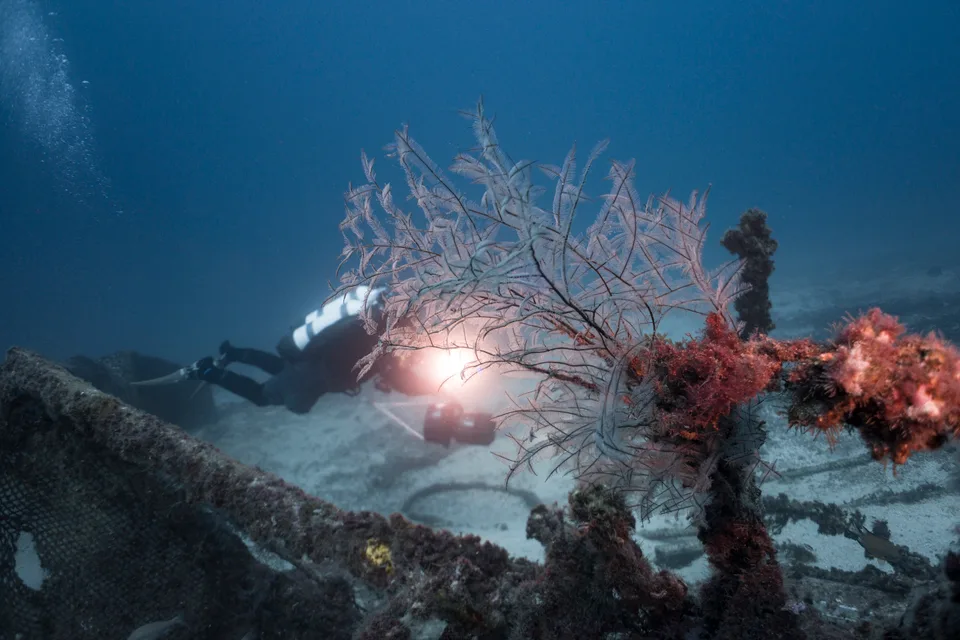
Freshwater environments, often found in ponds and streams.
Distribution
Found in various freshwater bodies across Europe and North America.
Conservation status
Not Evaluated
Edibility
Not edible and not collected for food. Avoid handling because its stinging cells may irritate skin.
Danger level
Caution
Usual observation depth
10–50 m
Behaviour
Sessile colonial cnidarian. Feeding polyps extend their tentacles to capture passing plankton; colonies reproduce through specialized reproductive structures.
Observation zones
Rocky reefs, drop-offs, overhangs, wrecks, pillars and other hard artificial structures.
Diet
Microzooplankton and other tiny suspended animals, captured with tentacles equipped with stinging cells.
Reproduction
Unknown
Identification marks
Upright, feather-shaped colony, with a central stem bearing regularly arranged lateral branches. Colonies are generally pale brown to yellowish and can reach approximately 30 cm in height.
Similar species
It may resemble other feather-like hydroids, notably Nemertesia ramosa and species of Aglaophenia. Reliable identification may require examination of the branching pattern and reproductive structures.
Approach rules
Observe without touching. Maintain good buoyancy and avoid brushing against the colony with skin, gloves, fins or equipment. Do not feed or collect specimens; use flash in moderation and avoid repeated flashes at very close range.
Protection
No global IUCN assessment or CITES listing is known for Nemertesia antennina. Avoid unnecessary collection and any degradation of colonies or their hard-substrate habitat.