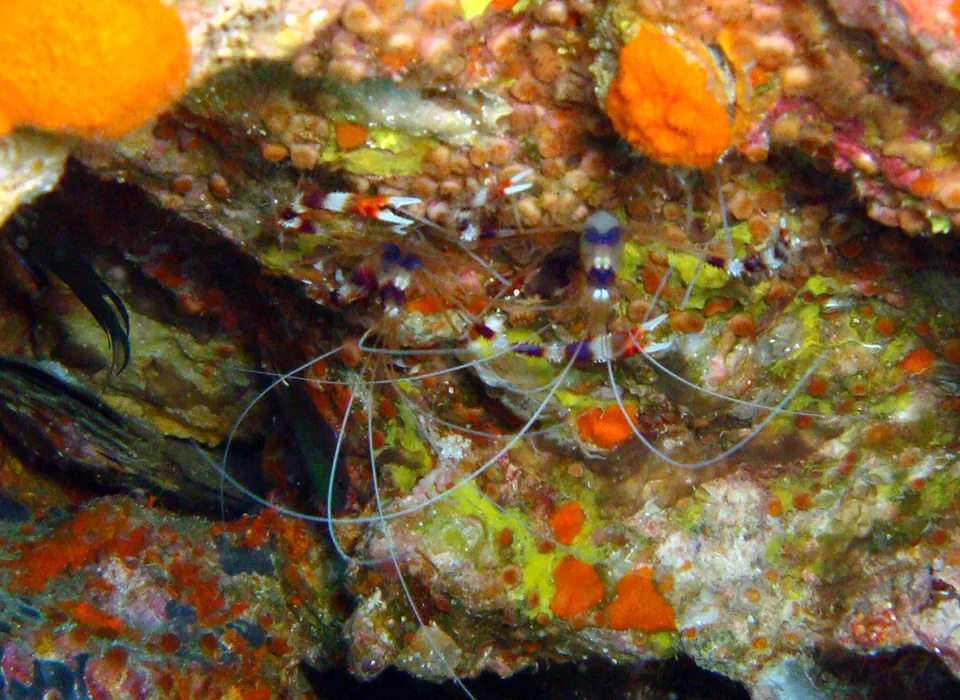
Found in the Indian Ocean, particularly around South Africa.
Conservation status
Least Concern
Edibility
Not documented as a food species and far too small for practical harvest. Do not collect reef shrimp for consumption.
Danger level
Harmless
Usual observation depth
2–25 m
Behaviour
Primarily nocturnal benthic shrimp. It is often found in small groups in protected reef crevices and performs characteristic swaying movements, especially when disturbed or feeding.
Opportunistic omnivore and detritivore, feeding on small benthic invertebrates, detritus, algae and organic particles.
Reproduction
Oviparous
Identification marks
Small shrimp with a strongly upturned and mobile rostrum, a distinctly humped silhouette, long antennae, and a body finely marked with reddish to brownish coloration. The articulated rostrum is an essential characteristic of Rhynchocinetes shrimp.
Similar species
May be confused with other species of Rhynchocinetes, notably R. uritai and R. rigens. Color alone is not reliable; certain identification may require close examination of the rostral teeth and other morphological characters.
Approach rules
Approach slowly and stay outside the crevice. Do not touch, handle, or feed the animal, and do not block its retreat. Use moderate lighting; avoid close or repeated flashes.
Protection
No specific international protection listing is known for this species. Protect reef habitat and avoid any unnecessary collection or disturbance.